
|
You entered: neutron star
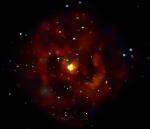 X Rays from M83
6.02.2003
Bright and beautiful spiral galaxy M83 lies a mere twelve million light-years from Earth, toward the headstrong constellation Hydra. Sweeping spiral arms, prominent in visible light images, lend this galaxy its popular moniker -- the Southern Pinwheel.
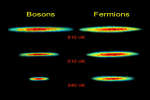 Pauli Exclusion Principle: Why You Don't Implode
28.02.2010
Why doesn't matter just bunch up? The same principle that keeps neutron stars and white dwarf stars from imploding also keeps people from imploding and makes normal matter mostly empty space. The observed reason is known as the Pauli Exclusion Principle.
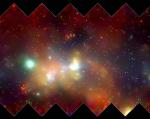 X Ray Milky Way
10.01.2002
If you had x-ray vision, the center regions of our galaxy would not be hidden from view by immense cosmic dust clouds opaque to visible light. Instead, the Milky Way toward Sagittarius might look something like this stunning mosaic of images from the orbiting Chandra Observatory.
 X Ray Milky Way
12.07.2003
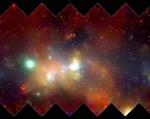
If you had x-ray vision, the center regions of our Galaxy would not be hidden from view by the immense cosmic dust clouds opaque to visible light. Instead, the Milky Way toward Sagittarius might look something like this stunning mosaic of images from the orbiting Chandra Observatory.
 Magnetar In The Sky
2.10.1998
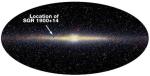
Indicated on this infrared image of the galactic center region is the position of SGR 1900+14 - the strongest known magnet in the galaxy. SGR 1900+14 is believed to be a city-sized, spinning, super-magnetic neutron star, or Magnetar. How strong is a Magnetar's magnetic field?
 Magnetar In The Sky
22.01.2000
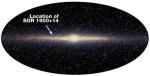
Indicated on this infrared image of the galactic center region is the position of SGR 1900+14 - the strongest known magnet in the galaxy. SGR 1900+14 is believed to be a city-sized, spinning, super-magnetic neutron star, or Magnetar. How strong is a Magnetar's magnetic field?
 ULXs in M74
30.03.2005
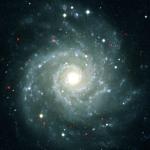
In visual appearance, M74 is a nearly perfect face-on spiral galaxy, about 30 million light-years away toward the constellation Pisces. The red blotches seen in this composite view are ultraluminous x-ray sources (ULXs) mapped by the Chandra X-ray Observatory.
 APOD: 2026 July 24 Б RCW 86: Historical Supernova Remnant
24.07.2026
In 185 AD, Chinese astronomers recorded the appearance of a new star in the Nanmen asterism. That part of the sky is identified with part of the southern constellation Centaurus on modern star charts.
 SN 2006GY: Brightest Supernova
10.05.2007
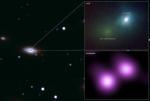
The stellar explosion cataloged as supernova SN 2006gy shines in this wide-field image (left) of its host galaxy, NGC 1260, and expanded view (upper right panel) of the region surrounding the galaxy's core.
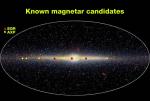 Magnetars In The Sky
26.11.2004
Indicated on this infrared image of the galactic center region are positions of candidate magnetars -- believed to be the strongest magnets in the galaxy. Classified by observers as Soft Gamma Repeaters (SGRs) and Anomalous X-ray Pulsars (AXPs), these cosmic powerhouses are likely city-sized, spinning, highly-magnetized neutron stars. How strong is a magnetar's magnetic field?
|
January February March April May June July August September October |
|||||||||||||||||||||||||||||||||||||||||||||||||