
|
You entered: pleiades
 APOD: 2025 April 8 Б Moon Visits Sister Stars
8.04.2025
Sometimes, the Moon visits the Pleiades. Technically, this means that the orbit of our Moon takes it directly in front of the famous Pleiades star cluster, which is far in the distance. The technical...
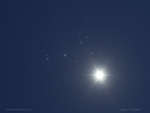 Venus and the Sisters
4.04.2020
After wandering about as far from the Sun on the sky as Venus can get, the brilliant evening star is crossing paths with the sister stars of the Pleiades cluster. Look west after sunset and you can share the ongoing conjunction with skygazers around the world.
 APOD: 2025 March 5 Б Seven Sisters versus California
5.03.2025
On the right, dressed in blue, is the Pleiades. Also known as the Seven Sisters and M45, the Pleiades is one of the brightest and most easily visible open clusters on the sky. The Pleiades contains over 3,000 stars, is about 400 light years away, and only 13 light years across.
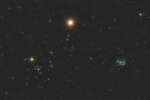 Mars and the Star Clusters
30.12.2022
At this year's end Mars still shines brightly in planet Earth's night as it wanders through the head-strong constellation Taurus. Its bright yellowish hue dominates this starry field of view that includes Taurus' alpha star Aldebaran and the Hyades and Pleiades star clusters.
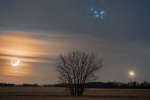 A Cosmic Triangle
15.04.2020
It was an astronomical triple play. Setting on the left, just after sunset near the end of last month, was our Moon -- showing a bright crescent phase. Setting on the right was Venus, the brightest planet in the evening sky last month -- and this month, too.
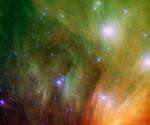 Seven Dusty Sisters
13.04.2007
Hurtling through a cosmic dust cloud a mere 400 light-years away, the lovely Pleiades or Seven Sisters star cluster is well-known in astronomical images for its striking blue reflection nebulae. At visible wavelengths...
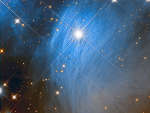 Meropes Reflection Nebula
15.02.2012
Reflection nebulas reflect light from a nearby star. Many small carbon grains in the nebula reflect the light. The blue color typical of reflection nebula is caused by blue light being more efficiently scattered by the carbon dust than red light.
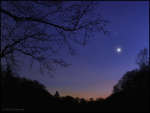 Venus in the West
11.04.2015
In the coming days, Venus shines near the western horizon at sunset. To find Earth's sister planet in twilight skies just look for the brilliant evening star. Tonight very close to the Pleiades...
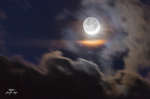 APOD: 2026 April 24 Б Young Moon and Sister Stars
24.04.2026
Sunlit arms of a crescent moon seem to embrace the faint lunar night side in this dramatic celestial scene from planet Earth. The single telephoto exposure tracking the sky was captured on the night of April 19, when a two day old Moon was near perigee in its elliptical orbit.
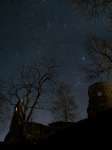 Starry Night Castle
19.01.2008
The tantalizing Pleiades star cluster seems to lie just beyond the trees above a dark castle tower in this dramatic view of The World at Night. Recorded earlier this month, the starry sky also...
|
January February March April May June July August September October |
|||||||||||||||||||||||||||||||||||||||||||||||||