
|
You entered: prominence
 APOD: 2025 July 30 Б Coronal Loops on the Sun
29.07.2025
Our Sun frequently erupts in loops. Hot solar plasma jumps off the Sun's surface into prominences, with the most common type of prominence being a simple loop. The loop shape originates from the Sun's magnetic field, which is traced by spiraling electrons and protons.
 Sirius: The Brightest Star in the Night
11.06.2000
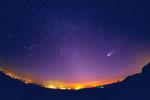
Sirius is the brightest star in the night sky. Sirius is visible on the far left of the above photograph, to the left of the constellation of Orion and Comet Hale-Bopp. Intrinsically, Sirius is over 20 times brighter than our Sun and over twice as massive.
 Solstice Celebration
21.06.2000
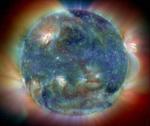
Season's greetings! At 01:48 Universal Time on June 21 the Sun reaches its northernmost point in planet Earth's sky marking a season change and the first solstice of the year 2000. In celebration, consider this delightfully detailed, brightly colored image of the active Sun.
 Moon AND Sun
21.11.2003
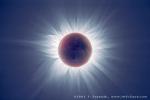
This composite image was made from 22 separate pictures of the Moon and Sun all taken from Chisamba, Zambia during the total phase of the 2001 June 21 solar eclipse. The multiple exposures were...
 Solstice Celebration
20.06.2004
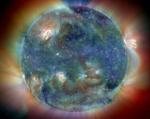
Season's greetings! Today or tomorrow, depending on your time zone, the Sun reaches its northernmost point in planet Earth's sky marking a season change and the first solstice of the year 2004. In celebration, consider this delightfully detailed, brightly colored image of the active Sun.
 The Flash Spectrum of the Sun
11.03.2016
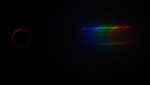
In a flash, the visible spectrum of the Sun changed from absorption to emission on March 9 during the total solar eclipse. That fleeting moment, at the beginning the total eclipse phase, is captured by telephoto lens and diffraction grating in this image from clearing skies over Ternate, Indonesia.
 Solstice Celebration
20.12.2002
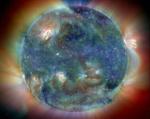
Aloha and Season's greetings! On December 22nd, at 01:14 Universal Time (December 21, 3:14pm Hawaii-Aleutian Standard Time), the Sun reaches its southernmost point in planet Earth's sky marking the final season change for the year 2002. In celebration, consider this delightfully detailed, brightly colored image of the active Sun.
 APOD: 2026 August 17 Б A Golden Corona Eclipse
16.08.2026
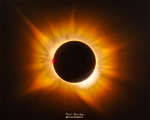
This total solar eclipse appeared not only poetically beautiful but scientifically interesting. Usually the solar corona appears white, and to some observers the corona of last week's total solar eclipse did appear this pearly color. But this time, totality observers in Spain saw a corona that appeared unusually golden.
 An Extremely Long Filament on the Sun
9.02.2015
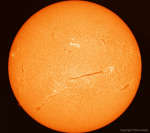
Yesterday, the Sun exhibited one of the longest filaments ever recorded. It may still be there today. Visible as the dark streak just below the center in the featured image, the enormous filament extended across the face of the Sun a distance even longer than the Sun's radius -- over 700,000 kilometers.
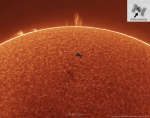 Space Station, Solar Prominences, Sun
3.05.2021
That's no sunspot. It's the International Space Station (ISS) caught passing in front of the Sun. Sunspots, individually, have a dark central umbra, a lighter surrounding penumbra, and no Dragon capsules attached.
|
January February March April May June July August September October |
|||||||||||||||||||||||||||||||||||||||||||||||||