
|
You entered: quasar
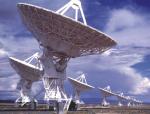 The Very Large Array of Radio Telescopes
28.05.2002
The most photogenic array of radio telescopes in the world has also been one of the most productive. Each of the 27 radio telescopes in the Very Large Array (VLA) is the size of a house and can be moved on train tracks.
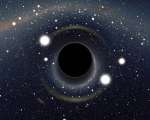 Too Close to a Black Hole
26.10.2014
What would you see if you went right up to a black hole? Featured is a computer generated image highlighting how strange things would look. The black hole has such strong gravity that light is noticeably bent towards it - causing some very unusual visual distortions.
 Releasing Compton
29.11.1995
Named for Nobel laureate physicist Arthur Holly Compton, the Compton Gamma Ray Observatory (CGRO) Satellite was launched in April of 1991 aboard the Space Shuttle Atlantis. CGRO's mission is to explore the Universe at gamma-ray energies.
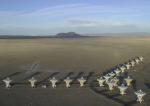 The Very Large Array of Radio Telescopes
14.05.2006
The most photogenic array of radio telescopes in the world has also been one of the most productive. Each of the 27 radio telescopes in the Very Large Array (VLA) is the size of a house and can be moved on train tracks.
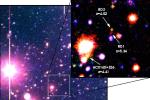 A Baby Galaxy
24.03.1998
What's the farthest galaxy known? The answer keeps changing as astronomers compete to find new galaxies which top the list. The new record holder is now the faint red smudge indicated in the above image by the arrow.
 The Gamma Ray Sky
21.03.1998
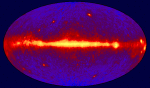
What if you could "see" gamma rays? If you could, the sky would seem to be filled with a shimmering high-energy glow from the most exotic and mysterious objects in the Universe.
 Dusty Spiral M66
2.09.2006
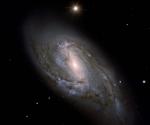
When morning twilight came to the Paranal Observatory in Chile, astronomers Mark Neeser and Peter Barthel interrupted their search for faint quasars, billions of light-years away. And just for a moment, they used Very Large Telescopes at the European Southern Observatory to appreciate the beauty of the nearby Universe.
 A Very Large Array of Radio Telescopes
20.06.1999
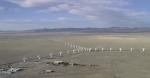
Pictured above is one of the world's premiere radio astronomical observatories: The Very Large Array (VLA). Each antenna dish is as big as a house (25 meters across) and mounted on railroad tracks. The VLA consists of 27 dishes - together capable of spanning the size of a city (35 kilometers).
 The Gamma Ray Sky
22.02.1997
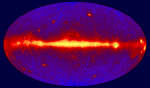
What if you could "see" gamma rays? If you could, the sky would seem to be filled with a shimmering high-energy glow from the most exotic and mysterious objects in the Universe.
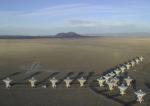 The Very Large Array Turns Twenty
30.05.2000
The most photogenic array of radio telescopes in the world has also been one of the most productive. Each of the 27 radio telescopes in the Very Large Array (VLA) is the size of a house and can be moved on train tracks.
|
January February March April May June July August September October |
|||||||||||||||||||||||||||||||||||||||||||||||||