
|
You entered: red dwarf
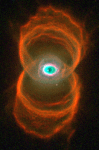 MyCn18: An Hourglass Nebula
18.01.1996
The sands of time are running out for the central star of this hourglass-shaped planetary nebula. With its nuclear fuel exhausted, this brief, spectacular, closing phase of a Sun-like star's life occurs as its outer layers are ejected - its core becoming a cooling, fading White Dwarf.
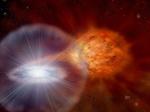 Explosions from White Dwarf Star RS Oph
26.07.2006
Spectacular explosions keep occurring in the binary star system named RS Ophiuchi. Every 20 years or so, the red giant star dumps enough hydrogen gas onto its companion white dwarf star to set off a brilliant thermonuclear explosion on the white dwarf's surface.
 APOD: 2023 August 14 Б The Ring Nebula from Webb
14.08.2023
The Ring Nebula (M57), is more complicated than it appears through a small telescope. The easily visible central ring is about one light-year across, but this remarkable exposure by the James Webb Space Telescope explores this popular nebula with a deep exposure in infrared light.
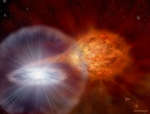 Explosions from White Dwarf Star RS Oph
22.08.2021
Spectacular explosions keep occurring in the binary star system named RS Ophiuchi. Every 20 years or so, the red giant star dumps enough hydrogen gas onto its companion white dwarf star to set off a brilliant thermonuclear explosion on the white dwarf's surface.
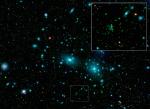 Dwarf Galaxies in the Coma Cluster
31.05.2007
In visible light images, over a thousand galaxies are seen to lie within a volume about 20 million light-years across in the rich Coma Galaxy Cluster. But infrared images of the Coma Cluster have now been used to add thousands more to the Coma's galaxy count in the form of previously undiscovered dwarf galaxies.
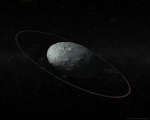 Haumea of the Outer Solar System
17.10.2017
One of the strangest objects in the outer Solar System has recently been found to have a ring. The object, named Haumea, is the fifth designated dwarf planet after Pluto, Ceres, Eris, and Makemake. Haumea's oblong shape makes it quite unusual.
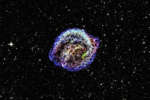 Kepler's Supernova Remnant in X Rays
15.05.2013
What caused this mess? Some type of star exploded to create the unusually shaped nebula known as Kepler's supernova remnant, but which type? Light from the stellar explosion that created this energized cosmic cloud was first seen on planet Earth in October 1604, a mere four hundred years ago.
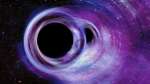 APOD: 2026 April Б Caught in the Web
3.04.2026
How can we see what is invisible? Black holes are not easy to see in the dark cosmic night, but astronomers can find them by analyzing their gravitational effects on matter, light and spacetime.
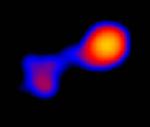 Mira: The Wonderful Star
22.07.2006
To seventeenth century astronomers, Omicron Ceti or Mira was known as a wonderful star - a star whose brightness could change dramatically in the course of about 11 months. Modern astronomers now recognize an entire class of long period Mira-type variables as cool, pulsating, red giant stars, 700 or so times the diameter of the Sun.
 Mira: The Wonderful Star
5.05.2005
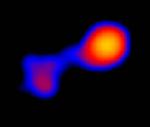
To seventeenth century astronomers, Omicron Ceti or Mira was known as a wonderful star - a star whose brightness could change dramatically in the course of about 11 months. Modern astronomers now recognize an entire class of long period Mira-type variables as cool, pulsating, red giant stars, 700 or so times the diameter of the Sun.
|
January February March April May June July August September |
|||||||||||||||||||||||||||||||||||||||||||||||||