
|
You entered: red giant
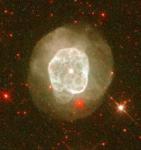 Nebulae For Christmas
25.12.1998
If our Galaxy were a Christmas tree, planetary nebulae would adorn it like colorful lighted ornaments twinkling on a cosmic scale. Glowing shrouds of gas ejected by red giant stars, planetary nebulae like...
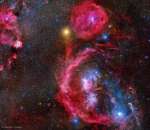 A 212 Hour Exposure of Orion
29.03.2020
The constellation of Orion is much more than three stars in a row. It is a direction in space that is rich with impressive nebulas. To better appreciate this well-known swath of sky, an extremely long exposure was taken over many clear nights in 2013 and 2014.
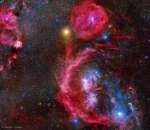 A 212 Hour Exposure of Orion
23.11.2015
The constellation of Orion is much more than three stars in a row. It is a direction in space that is rich with impressive nebulas. To better appreciate this well-known swath of sky, an extremely long exposure was taken over many clear nights in 2013 and 2014.
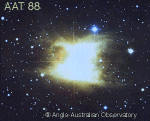 The Toby Jug Nebula
5.01.1996
Is the only thing unusual about this nebula its shape? Pictured above is the IC 2220 - the Toby Jug Nebula - a reflection nebula surrounding a normal red giant star. Reflection nebulae shine by light reflected from the central star(s).
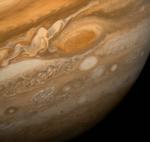 Jupiter from Voyager
18.07.1999
This picture of the planet Jupiter was taken by the Voyager 1 spacecraft as it passed the planet in 1979. Jupiter, a gas giant planet with no solid surface, is the largest planet in the Solar System and is made mostly of the hydrogen and helium.
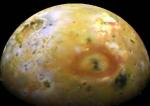 Io's Giant Volcano Pele
5.12.1996
Io has some very large volcanoes. One of the largest is evident near the center of the above photograph and named Pele, for the mythological Polynesian fire goddess. The Galileo spacecraft now orbiting Jupiter took this picture of Jupiter's most active moon in June, although it was released just last week.
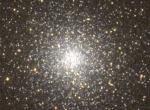 Globular Cluster 47 Tucanae
19.09.1997
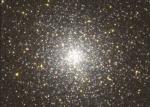
Stars come in bunches. Of the over 200 globular star clusters that orbit the center of our Milky Way Galaxy, 47 Tucanae is the second brightest globular cluster (behind Omega Centauri). Known to some affectionately as 47 Tuc or NGC 104, it is only visible from the Southern Hemisphere.
 Globular Cluster 47 Tucanae
22.04.2001
Stars come in bunches. Of the over 200 globular star clusters that orbit the center of our Milky Way Galaxy, 47 Tucanae is the second brightest globular cluster (behind Omega Centauri). Known to some affectionately as 47 Tuc or NGC 104, it is only visible from the Southern Hemisphere.
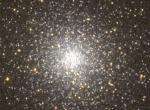 Globular Cluster 47 Tucanae
7.11.1998
Stars come in bunches. Of the over 200 globular star clusters that orbit the center of our Milky Way Galaxy, 47 Tucanae is the second brightest globular cluster (behind Omega Centauri). Known to some affectionately as 47 Tuc or NGC 104, it is only visible from the Southern
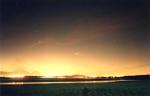 Hale-Bopp: Climbing Into Southern Skies
15.05.1997
Fighting the glow of the setting sun and the city lights of Cape Town, South Africa, comet Hale-Bopp is just visible near the center of this panoramic view - photographed on May 3rd.
|
January February March April May June July August September October |
|||||||||||||||||||||||||||||||||||||||||||||||||