
|
You entered: space observations
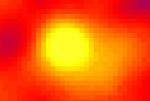 GRB970228: What's There?
7.04.1997
Could this fuzzy blob be the key to the whole gamma-ray burst (GRB) mystery? Astronomers the world over are now scrambling to determine the true nature of the extended emission seen to the lower right of the bright source in the above image.
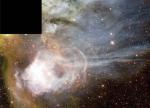 N44C: A Nebular Mystery
14.05.2002
Why is N44C glowing so strangely? The star that appears to powers the nebula, although young and bright, does not seem hot enough to create some of the colors observed. A search for a hidden hotter star in X-rays has come up empty.
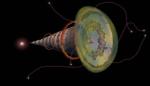 Cosmic Rays and Supernova Dust
18.06.1998
Cosmic Rays are celestial high energy particles traveling at nearly the speed of light, which constantly bombard the Earth. Discovered during high altitude balloon flights in 1912 their source has been a long standing mystery.
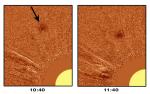 Coronal Inflow
29.11.2001
The active Sun has thrown a lot our way lately, including storms of particles streaming outward in the solar wind and clouds of plasma which triggered awesome auroral displays. Still, a growing body...
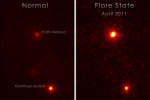 An Unexpected Flare from the Crab Nebula
23.05.2011
Why does the Crab Nebula flare? No one is sure. The unusual behavior, discovered over the past few years, seems only to occur in very high energy light -- gamma rays. As recently...
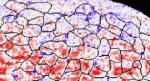 The Solar Wind Emerges
8.02.1999
Winds of fast particles blow out from the Sun, but why? Astronomers came a step closer to answering this question recently by making detailed observations of the high-speed wind source with the space-borne Solar and Heliospheric Observatory (SOHO).
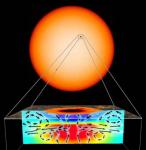 Under A Sunspot
8.11.2001
At the Sun's surface, sunspots are known to be dark, planet-sized regions of intense magnetic fields. But what lies below? Using observations from the Michelson Doppler Imager (MDI) instrument aboard the space-based SOHO observatory, astronomers have derived this premier picture of the flow of material just beneath a visible sunspot.
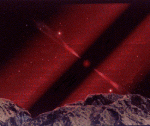 Planet Near a Galaxy Core
5.05.1996
What would the night sky look like if you lived on a planet near the center of a galaxy? Now imagine that this galaxy houses a black hole billions of times more massive than a star. From this spectacular vantage point, the sky might look like the above illustration.
 A Dark Pulsar in CTA 1
21.10.2008
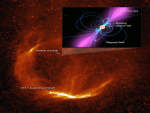
Where's the pulsar? Previously, the nebula CTA 1 showed an expanding supernova remnant, a jet, and a point source expected to be a pulsar -- a rotating neutron star producing pulses at radio energies. But no radio pulses were detected.
 Jupiters Europa from Spacecraft Galileo
27.09.2016
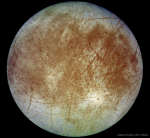
What mysteries might be solved by peering into this crystal ball? In this case, the ball is actually a moon of Jupiter, the crystals are ice, and the moon is not only dirty but cracked beyond repair. Nevertheless, speculation is rampant that oceans exist under Europa's fractured ice-plains that could support life.
|
January February March April May June July August September October |
|||||||||||||||||||||||||||||||||||||||||||||||||