
|
You entered: transit
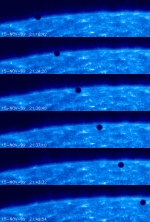 Mercury And The Sun
19.11.1999
Just days before the peak of the Leonid meteor shower, skywatchers were offered another astronomical treat as planet Mercury crossed the face of the Sun on November 15. Viewed from planet Earth, a transit of Mercury is not all that rare. The last occurred in 1993 and the next will happen in 2003.
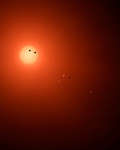 Seven Worlds for TRAPPIST 1
23.02.2017
Seven worlds orbit the ultracool dwarf star TRAPPIST-1, a mere 40 light-years away. In May 2016 astronomers using the Transiting Planets and Planetesimals Small Telescope (TRAPPIST) announced the discovery of three planets in the TRAPPIST-1 system.
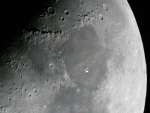 Space Station in the Moon
6.02.2009
On February 2nd, a first quarter Moon shone in planet Earth's early evening sky. As seen from a location on the US west coast near Mt. Hamilton, California, the International Space Station also arched above the horizon, crossing in front of the Moon's sunlit surface. The space station's transit lasted 0.49 seconds.
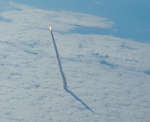 Space Shuttle Rising
15.04.2018
What's that rising from the clouds? The space shuttle. Sometimes, if you look out the window of an airplane at just the right time and place, you see something unusual -- in this case a space shuttle launching to orbit.
 Spot The Planet
10.12.1999
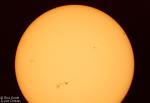
OK, it's a picture of the Sun (duh!), but can you spot the planet? Of course, most of the spots you've spotted are sunspots, as large or larger than planet Earth itself.
 TESS Launch Close Up
21.04.2018
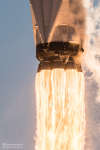
NASA's Transiting Exoplanet Survey Satellite (TESS) began its search for planets orbiting other stars by leaving planet Earth on April 18. The exoplanet hunter rode to orbit on top of a Falcon 9 rocket.
 Pixels in the Sun
26.06.2021
These two panels, composed of video frames made with a safe solar telescope and hydrogen alpha filter, show remarkably sharp details on the solar disk and giant prominences along the Sun's edge on June 6 (top) and June 18.
 Venus Returns to the Evening Sky
9.06.2005
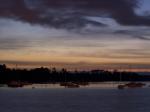
This serene image of boats moored in the harbor of l'нle-Tudy, Bretagne, France was taken on June 1st, about an hour after sunset. It also features Venus, third brightest celestial object after the Sun and Moon.
 Three Worlds for TRAPPIST 1
7.05.2016
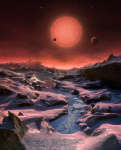
Three new found worlds orbit the ultracool dwarf star TRAPPIST-1, a mere 40 light-years away. Their transits were first detected by the Belgian robotic TRAnsiting Planets and Planetesimals Small Telescope, TRAPPIST, at ESO's La Silla Observatory in Chile. The newly discovered exoplanets are all similar in size to Earth.
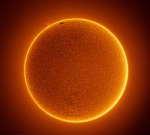 The Space Station Crosses a Spotless Sun
15.07.2019
That's no sunspot. It's the International Space Station (ISS) caught passing in front of the Sun. Sunspots, individually, have a dark central umbra, a lighter surrounding penumbra, and no solar panels. By contrast, the ISS is a complex and multi-spired mechanism, one of the largest and most sophisticated machines ever created by humanity.
|
January February March April May June July August September October |
|||||||||||||||||||||||||||||||||||||||||||||||||