
|
You entered: dust cloud
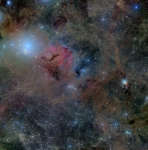 Stardust in Perseus
12.01.2023
This cosmic expanse of dust, gas, and stars covers some 6 degrees on the sky in the heroic constellation Perseus. At upper left in the gorgeous skyscape is the intriguing young star cluster IC 348 and neighboring Flying Ghost Nebula with clouds of obscuring interstellar dust cataloged as Barnard 3 and 4.
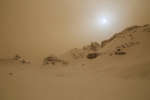 Swiss Alps, Martian Sky
18.02.2021
Taken on February 6, this snowy mountain and skyscape was captured near Melchsee-Frutt, central Switzerland, planet Earth. The reddish daylight and blue tinted glow around the afternoon Sun are colors of the Martian sky, though. Of course both worlds have the same Sun.
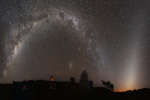 Zodiacal Light Over Namibia
13.09.2010
An unusual triangle of light is visible this time of year just before dawn, in the northern hemisphere. Once considered a false dawn, this triangle of light is actually zodiacal light, light reflected from interplanetary dust particles.
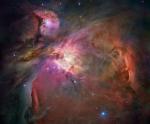 Orion Nebula, The Hubble View
19.01.2006
Few cosmic vistas excite the imagination like the Orion Nebula. Also known as M42, the nebula's glowing gas surrounds hot young stars at the edge of an immense interstellar molecular cloud only 1,500 light-years away.
 The Nebula And The Neutron Star
1.02.2003
The lonely RX J1856.5-3754 was formed from the collapsed core of an exploding star. At a distance of 180 light-years it is the closest known neutron star. More massive than...
 Bright Stars, Dim Galaxy
14.10.1996
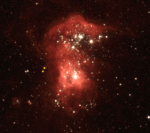
These two clusters of bright, newly formed stars surrounded by a glowing nebula lie 10 million light years away in the dim, irregular galaxy cataloged as NGC 2366. The Hubble Space Telescope image shows...
 Mauna Kea Milky Way Panorama
19.02.2009
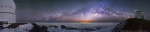
Aloha and welcome to a breathtaking skyscape. The dreamlike panoramic view looks out from the 4,200 meter volcanic summit of Mauna Kea, Hawai'i, across a layer of clouds toward a starry night sky and the rising Milky Way.
 Milky Way Panorama from Mauna Kea
10.03.2013
Aloha and welcome to a breathtaking skyscape. The dreamlike panoramic view looks out from the 4,200 meter volcanic summit of Mauna Kea, Hawai'i, across a layer of clouds toward a starry night sky and the rising Milky Way.
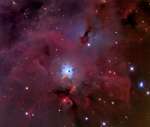 NGC 1999: South of Orion
24.02.2011
South of the large star-forming region known as the Orion Nebula, lies bright blue reflection nebula NGC 1999. Also at the edge of the Orion molecular cloud complex some 1,500 light-years distant, NGC 1999's illumination is provided by the embedded variable star V380 Orionis.
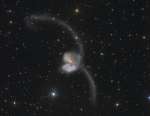 The Antennae
29.04.2011
Some 60 million light-years away in the southerly constellation Corvus, two large galaxies collided. But the stars in the two galaxies, cataloged as NGC 4038 and NGC 4039, don't collide in the course of the ponderous event, lasting hundreds of millions of years.
|
January February March April May June July August |
||||||||||||||||||||||||||||||||||||||||||||||||||||||||