
|
You entered: nearest stars
 Milky Way with Airglow Australis
3.09.2015
After sunset on September 1, an exceptionally intense, reddish airglow flooded this Chilean winter night skyscape. Above a sea of clouds and flanking the celestial Milky Way, the airglow seems to ripple and flow across the northern horizon in atmospheric waves.
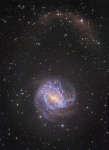 M83 Star Streams
17.01.2014
Big, bright, and beautiful, spiral galaxy M83 lies a mere twelve million light-years away, near the southeastern tip of the very long constellation Hydra. This deep view of the gorgeous island universe includes observations...
 APOD: 2024 June 17 Б Ou4: The Giant Squid Nebula
16.06.2024
Squids on Earth aren't this big. This mysterious squid-like cosmic cloud spans nearly three full moons on planet Earth's sky. Discovered in 2011 by French astro-imager Nicolas Outters, the Squid Nebula's bipolar shape is distinguished here by the telltale blue emission from doubly ionized oxygen atoms.
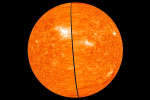 Sun 360: STEREO Captures Views of the Entire Sun
6.02.2011
For the first time, the entire Sun is being imaged all at once. This has become possible because the two STEREO satellites orbiting and monitoring the Sun are now on opposite sides of the Sun.
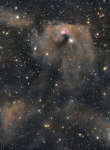 T Tauri and Hind s Variable Nebula
9.02.2022
The star with an orange tint near top center in this dusty telescopic frame is T Tauri, prototype of the class of T Tauri variable stars. Next to it (right) is a yellow cosmic cloud historically known as Hind's Variable Nebula (NGC 1555).
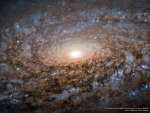 In the Center of Spiral Galaxy NGC 3521
29.11.2015
This huge swirling mass of stars, gas, and dust occurs near the center of a nearby spiral galaxy. Gorgeous spiral NGC 3521 is a mere 35 million light-years distant, toward the constellation Leo. Spanning some 50,000 light-years, its central region is shown in this dramatic image, constructed from data from the Hubble Space Telescope.
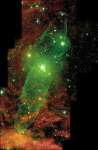 Ou4: A Giant Squid Nebula
18.07.2014
A mysterious, squid-like apparition, this nebula is very faint, but also very large in planet Earth's sky. In the mosaic image, composed with narrowband data from the 2.5 meter Isaac Newton Telescope, it spans some 2.5 full moons toward the constellation Cepheus.
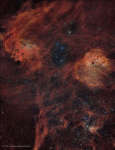 Nebulae in Aurigae
30.11.2015
Rich in star clusters and nebulae, the ancient constellation of the Charioteer (Auriga) rides high in northern winter night skies. Composed from narrow and broadband filter data and spanning nearly 8 Full Moons (4 degrees) on the sky, this deep telescopic view shows off some of Auriga's celestial bounty.
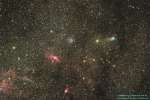 Comet Lemmon and the Deep Sky
20.07.2013
Now sweeping high above the ecliptic plane, Comet Lemmon has faded dramatically in planet Earth's night sky as it heads for the outer solar system. Some 16 light-minutes (2 AU) from...
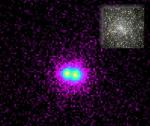 X Ray Stars in M15
20.09.2001
Side by side, two x-ray stars greeted astronomers in this false-color Chandra Observatory x-ray image of a region near the core of globular star cluster M15. The greeting was a pleasant surprise, as all previous x-ray images of the cluster showed only one such source where Chandra's sharper x-ray vision now reveals two.
|
January February March April May June July August September |
|||||||||||||||||||||||||||||||||||||||||||||||||