
|
You entered: Earth orbit
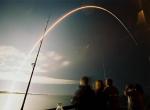 SIRTF Streak
5.09.2003
Streaking skyward, a Boeing Delta 2-Heavy rocket carries NASA's Space InfraRed Telescope Facility (SIRTF) aloft during the early morning hours of August 25th. The dramatic scene was recorded in a time exposure from...
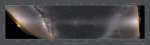 Zodiacal Light Panorama
5.04.2012
Sweeping from the eastern to western horizon, this 360 degree panorama follows the band of zodiacal light along the solar system's ecliptic plane. Dust scattering sunlight produces the faint zodiacal glow that spans...
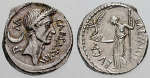 Julius Caesar and Leap Days
29.02.2020
In 46 BC Julius Caesar reformed the calendar system. Based on advice by astronomer Sosigenes of Alexandria, the Julian calendar included one leap day every four years to account for the fact that an Earth year is slightly more than 365 days long.
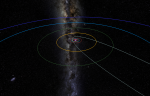 Animation: Perseid Meteor Shower
8.08.2018
Where do Perseid meteors come from? Mostly small bits of stony grit, Perseid meteoroids were once expelled from Comet Swift-Tuttle and continue to follow this comet's orbit as they slowly disperse. The featured animation depicts the entire meteoroid stream as it orbits our Sun.
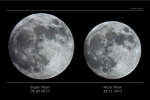 Super Moon vs Micro Moon
13.11.2016
What is so super about tomorrow's supermoon? Tomorrow, a full moon will occur that appears slightly larger and brighter than usual. The reason is that the Moon's fully illuminated phase occurs within a short time from perigee - when the Moon is its closest to the Earth in its elliptical orbit.
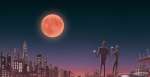 Tonight: A Supermoon Lunar Eclipse
27.09.2015
Tonight a bright full Moon will fade to red. Tonight's moon will be particularly bright because it is reaching its fully lit phase when it is relatively close to the Earth in its elliptical orbit.
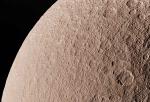 Rhea: Saturns Second Largest Moon
5.12.1999
Rhea is the second largest moon of Saturn, behind Titan, and the largest without an atmosphere. It is composed mostly of water ice, but has a small rocky core. Rhea's rotation and orbit are locked together (just like Earth's Moon) so that one side always faces Saturn.
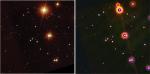 GRB 060218: A Mysterious Transient
27.02.2006
What is it? Something is happening in a small portion of the sky toward the constellation of Aries and telescopes around the globe are tracking an unusual transient there as it changes day by day. No one is sure what it will do next.
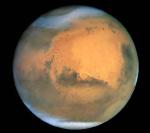 Mars from Earth
18.07.2001
Last month, Mars and Earth were right next to each other in their orbits. Formally called opposition, the event was highlighted by a very bright Mars for skywatchers and a good photo opportunity for the Hubble Space Telescope. Above, Hubble snapped the highest resolution picture of Mars ever obtained from the Earth.
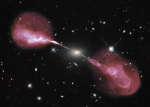 Plasma Jets from Radio Galaxy Hercules A
5.12.2012
Why does this galaxy emit such spectacular jets? No one is sure, but it is likely related to an active supermassive black hole at its center. The galaxy at the image center, Hercules A, appears to be a relatively normal elliptical galaxy in visible light.
|
January February March April May June July August September October |
|||||||||||||||||||||||||||||||||||||||||||||||||