
|
You entered: Milky Way
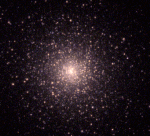 M15: A Great Globular Cluster
26.07.1995
A globular cluster is a system of about one million stars that together orbit a galaxy. One of the brightest globular clusters in our Milky Way galaxy is the pictured M15, the fifteenth object on Messier's list of diffuse objects on our sky.
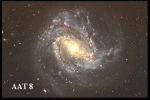 Spiral Galaxy M83
12.09.1995
Long winding spiral arms are clearly evident on this spectacular picture of the spiral galaxy M83. The blue color of the spiral arms is caused by the relatively large fraction of young blue stars there. Dark dust lanes are mixed in with the stars and trace the spiral structure of the galaxy.
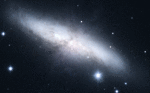 Unusual M82: The Cigar Galaxy
15.03.1998
Something strange happened to this galaxy, but what? M82 is a nearby galaxy in the group of galaxies dominated by itself, M81, and NGC 3077. M82 is thought by some to be limping away from a close encounter with M81.
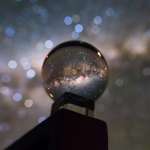 Galaxy in a Crystal Ball
22.06.2018
A small crystal ball seems to hold a whole galaxy in this creative snapshot. Of course, the galaxy is our own Milky Way. Its luminous central bulge marked by rifts of interstellar dust spans thousands of light-years. On this long southern hemisphere night it filled dark Chilean skies over Paranal Observatory.
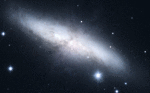 Unusual M82: The Cigar Galaxy
18.11.1996
Something strange happened to this galaxy, but what? M82 is a nearby galaxy in the group of galaxies dominated by itself, M81, and NGC 3077. M82 is thought by some to be limping away from a close encounter with M81.
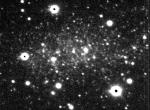 The Aquarius Dwarf
27.07.2003
Our Milky Way Galaxy is not alone. It is part of a gathering of about 50 galaxies known as the Local Group. Members include the Great Andromeda Galaxy (M31), M32, M33, the Large Magellanic Cloud, the Small Magellanic Cloud, Dwingeloo 1, several small irregular galaxies, and many dwarf elliptical and dwarf spheroidal galaxies.
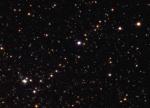 Kembles Cascade
14.08.2000
A picturesque chain of unrelated stars is visible with strong binoculars towards the constellation of Camelopardalis. Known as Kemble's Cascade, the asterism contains about 20 stars nearly in a row stretching over five times the width of a full moon.
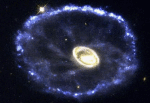 The Cartwheel Galaxy
2.07.1995
The Cartwheel Galaxy shows a ring that is the result of a collision between a small and a large galaxy. After a small galaxy has moved through a big galaxy - in this case...
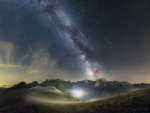 Perseids over the Pyrenees
18.08.2017
This mountain and night skyscape stretches across the French Pyrenees National Park on August 12, near the peak of the annual Perseid meteor shower. The multi-exposure panoramic view was composed from the Col d'Aubisque, a mountain pass, about an hour before the bright gibbous moon rose.
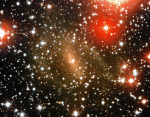 Galaxy Dwingeloo 1 Emerges
17.10.1995
If you look closely at the center of the above photograph, you will see a spiral galaxy behind the field of stars. Named Dwingeloo 1, this nearby galaxy was only discovered recently (1994) because much of its light was obscured by dust, gas and bright stars of our own Milky Way galaxy.
|
January February March April May June July August September October |
|||||||||||||||||||||||||||||||||||||||||||||||||