
|
You entered: planets
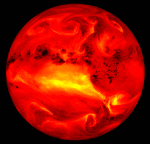 The Water Vapor Channel
9.05.1998
What alien planet's bizarre landscape lurks below these fiery-looking clouds? It's only Planet Earth, of course ... as seen on the Water Vapor Channel. Hourly, images like this one (an infrared image shown in false color) are brought to you by the orbiting Geostationary Operational Environmental Satellites' (GOES) multi-channel imagers.
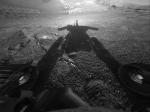 Shadow of a Martian Robot
3.08.2004
What if you saw your shadow on Mars and it wasn't human? Then you might be the Opportunity rover currently exploring Mars. Opportunity and sister robot Spirit have been probing the red planet since January, finding evidence of ancient water, and sending breathtaking images across the inner Solar System.
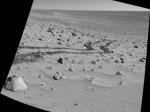 Looking Back Over Mars
15.12.2004
Pictured above, the path of the robot rover Spirit on Mars can be traced far into the distance. Spirit has now crossed kilometers of plains covered with rocks and sand, approached the lip of a crater 200-meters across, and climbed a series of hills.
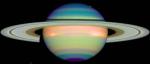 Infrared Saturn
24.07.1999
This delightfully detailed false color image of Saturn was earmarked to celebrate the 8th anniversary of the orbiting Hubble Space Telescope. The picture is a combination of three images taken in January 1998 and shows the lovely ringed planet in reflected infrared light.
 Children of the Sun
16.11.2006
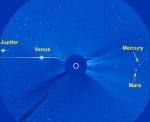
For a moment, planets Jupiter, Venus, Mars, and Mercury all posed near their parent star in this Sun-centered view, recorded on November 11. The picture, from a coronograph onboard the space-based SOlar Heliospheric Observatory, spans 15 degrees with the Sun's size and position indicated by the white circle.
 The Hill, The Moon, and Saturn
16.11.2018
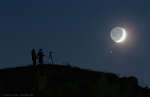
Last Sunday when the Moon was young its sunlit crescent hung low near the western horizon at sunset. With strong earthshine it was joined by Saturn shining in the early evening sky for a beautiful conjunction visible to skygazers around our fair planet.
 Swimming on Jupiter
14.12.2018
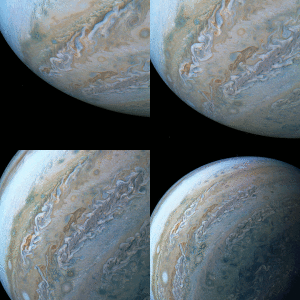
On October 29, the Juno spacecraft once again dove near the turbulent Jovian cloud tops. Its 16th orbital closest approach or perijove passage, brought Juno within 3,500 kilometers of the Solar System's largest planetary atmosphere.
 Jupiter Engulfed and the Milky Way
7.08.2019
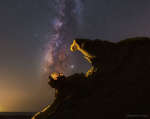
This is a good month to see Jupiter. To find our Solar System's largest planet in your sky, look toward the southeast just after sunset -- Jupiter should be the brightest object in that part of the sky.
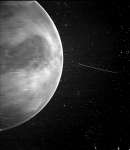 A Venus Flyby
25.02.2021
On a mission to explore the inner heliosphere and solar corona, on July 11, 2020 the Wide-field Imager on board NASA's Parker Solar Probe captured this stunning view of the nightside of Venus at distance of about 12,400 kilometers (7,693 miles).
 APOD: 2025 June 21 Б Two Worlds, Two Analemmas
21.06.2025
Sure, that figure-8 shaped curve you get when you mark the position of the Sun in Earth's sky at the same time each day over one year is called an analemma.
|
January February March April May June July August September October |
|||||||||||||||||||||||||||||||||||||||||||||||||