
|
You entered: Earth's moon
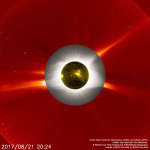 Layers of a Total Solar Eclipse
27.09.2017
Neither rain, nor snow, nor dark of night can keep a space-based spacecraft from watching the Sun. In fact, from its vantage point 1.5 million kilometers sunward of planet Earth, NASA's SOlar Heliospheric Observatory (SOHO) can always monitor the Sun's outer atmosphere, or corona.
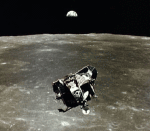 The Eagle Soars
21.07.1996
On July 21, 1969 Apollo 11 astronauts Neil A. Armstrong and Edwin E. "Buzz" Aldrin Jr. lifted off the lunar surface in the ascent stage of their lunar module dubbed "The Eagle" -- after becoming the first to walk on the moon.
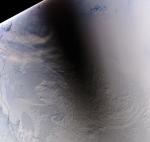 The Long Shadow of the Moon
27.11.2003
The long shadow of the Moon fell across the continent of Antarctica on November 23rd, during the second total solar eclipse of 2003. In this view from orbit, based on data from the MODIS instrument on board the Earth observing Aqua satellite, the Moon's shadow stretches for almost 500 kilometers.
 APOD: 2025 November 30 Б The Surface of Titan from Huygens
30.11.2025
If you could stand on Titan -- what would you see? The featured color viewa from Titan gazes across an unfamiliar and distant landscape on Saturn's largest moon. The scene was recorded by ESA's Huygens probe in 2005 after a 2.5-hour descent through a thick atmosphere of nitrogen laced with methane.
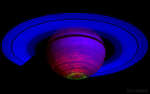 The Dancing Auroras of Saturn
27.06.2021
What drives auroras on Saturn? To help find out, scientists have sorted through hundreds of infrared images of Saturn taken by the Cassini spacecraft for other purposes, trying to find enough aurora images to correlate changes and make movies.
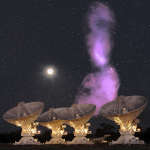 Centaurus Radio Jets Rising
13.04.2011
What if you could see the huge radio jets of Centaurus A rising? The Cen A radio jets are not only over a million light years long, they occupy an angular area over 200 times greater than the full Moon in Earth's sky.
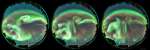 Auroral Substorm over Yellowknife
25.03.2011
Intense auroral activity flooded the night with shimmering colors on February 24, captured here from a lodge near the city of Yellowknife in northern Canada. The stunning sequence (left to right) of three all-sky exposures, taken at 30 second intervals, shows rapid changes in dancing curtains of northern lights against a starry background.
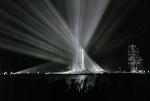 Happy Birthday Jules Verne
17.02.2001
One hundred seventy-three years ago on February 8th, Jules Verne was born in Nantes, France. Inspired by a lifelong fascination with machines, Verne wrote visionary works about "Extraordinary Voyages" including such terrestrial travels as Around the World in 80 Days, Journey to the Centre of the Earth, and Twenty Thousand Leagues Under the Sea.
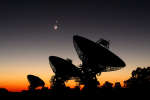 Planets Align Over Australian Radio Telescope Array
10.03.2008
Last week, Mercury, Venus, and the Moon all appeared close together in Earth's sky. This picturesque conjunction was caught on camera behind elements of the Australia Telescope Compact Array (ATCA) near the town of Narrabri in rural New South Wales.
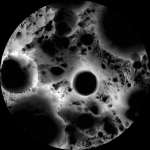 Shadows at the Lunar South Pole
23.04.2011
What is it? It's a multi-temporal illumination map, of course. To make it, the wide angle camera on the Lunar Reconnaissance Orbiter spacecraft collected 1,700 images over a period of 6 lunar days (6 Earth months), repeatedly covering an area centered on the Moon's south pole.
|
January February March April May June July August September |
|||||||||||||||||||||||||||||||||||||||||||||||||