
|
You entered: camera
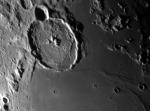 Lunar Close Up
12.02.1999
Late last month, NASA's Lunar Prospector spacecraft moved in for a closer look at the Moon. Now entering an extended mission phase, controllers have reduced the altitude of this polar lunar orbiter from 100 kilometers to about 30 kilometers (18 miles).
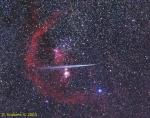 Rocket Fuel
16.11.2007
This gorgeous image of Orion shows off the constellation's young stars and cosmic clouds of hydrogen gas and dust. Made with a film camera tracking the stars on November 11, the exposure lasted some 40 minutes.
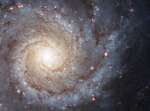 M74: The Perfect Spiral
1.12.2007
If not perfect, then this spiral galaxy is at least one of the most photogenic. An island universe of about 100 billion stars, 32 million light-years away toward the constellation Pisces, M74 presents a gorgeous face-on view.
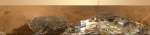 A Mars Panorama from the Phoenix Lander
13.03.2011
If you could stand on Mars, what would you see? The robotic Phoenix spacecraft that landed on Mars in 2008 recorded the above spectacular panorama. The above image is actually a digital combination of over 100 camera pointings and surveys fully 360 degrees around the busy robotic laboratory.
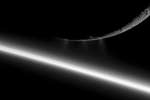 Enceladus Looms
12.05.2011
A sunlit crescent of Saturn's moon Enceladus looms above the night side of Saturn in this dramatic image from the Cassini spacecraft. Captured on August 13, 2010 looking in a sunward direction during...
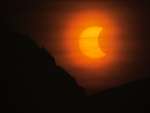 Solar Eclipse over Antarctica
2.12.2011
Last Friday, the fourth and final partial solar eclipse of 2011 was only visible from high latitudes in the southern hemisphere. If you missed it, check out this dramatic picture of the geocentric celestial event from a very high southern latitude on the continent of Antarctica.
 Tetons and Snake River, Planet Earth
1.08.2014
An alluring night skyscape, this scene looks west across the Grand Teton National Park, Wyoming, USA, Planet Earth. The Snake River glides through the foreground, while above the Tetons' rugged mountain peaks the starry sky is laced with exceptionally strong red and green airglow.
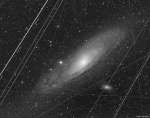 Andromeda before Photoshop
14.10.2019
What does the Andromeda galaxy really look like? The featured image shows how our Milky Way Galaxy's closest major galactic neighbor really appears in a long exposure through Earth's busy skies and with a digital camera that introduces normal imperfections.
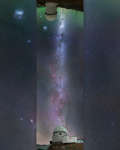 A 10 000 Kilometer Galactic Bridge
3.06.2022
With this creative astro-collaboration you can follow the plane of our Milky Way Galaxy as it bridges northern and southern hemisphere skies. To construct the expansive composite nightscape, skies over Observatorio El Sauce...
 Jupiter over 2 Hours and 30 Minutes
19.01.2024
Jupiter, our Solar System's ruling gas giant, is also the fastest spinning planet, rotating once in less than 10 hours. The gas giant doesn't rotate like a solid body though.
|
January February March April May June July August |
||||||||||||||||||||||||||||||||||||||||||||||||||||||||