
|
You entered: dark cloud
 Dim World, Dark Nebula
8.07.2010
Dim, distant, dwarf planet Pluto can be hard to spot, especially in recent months as it wanders through the crowded starfields of Sagittarius and the central Milky Way. But fortunately for backyard Pluto hunters, it crossed in front of a dark nebula in early July.
 Central Cygnus Skyscape
22.03.2017
In cosmic brush strokes of glowing hydrogen gas, this beautiful skyscape unfolds across the plane of our Milky Way Galaxy near the northern end of the Great Rift and the center of the constellation Cygnus the Swan. A 36 panel mosaic of telescopic image data, the scene spans about six degrees.
 Herschel s Orion
14.10.2016
This dramatic image peers within M42, the Orion Nebula, the closest large star-forming region. Using data at infrared wavelengths from the Herschel Space Observatory, the false-color composite explores the natal cosmic cloud a mere 1,500 light-years distant.
 NGC 6946: The Fireworks Galaxy
25.01.2005
Why is this galaxy so active? Nearby spiral galaxy NGC 6946 is undergoing a tremendous burst of star formation with no obvious cause. In many cases spirals light up when interacting with another galaxy, but NGC 6946 appears relatively isolated in space.
 Along the Taurus Molecular Cloud
23.11.2023
The cosmic brush of star formation composed this interstellar canvas of emission, dust, and dark nebulae. A 5 degree wide telescopic mosaic, it frames a region found north of bright star Aldebaran on the sky, at an inner wall of the local bubble along the Taurus molecular cloud.
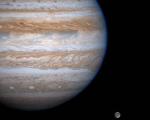 Jupiter Eyes Ganymede
12.12.2000
Who keeps an eye on the largest moon in the Solar System? This moon, visible on the lower right, is Ganymede, and the planet it orbits, Jupiter, seems to be keeping a watchful eye, as its Great Red Spot appears serendipitously nearby.
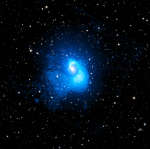 APOD: 2026 May 21 Б A Collision of Galaxy Clusters
21.05.2026
This big beautiful spiral shines in X-ray light. It is about 20 times larger than our Galaxy. It belongs to Abell 2029, a galaxy cluster one billion light-years away. (To see only the galaxies...
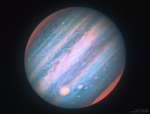 Jupiter in Infrared from Hubble
21.02.2018
Jupiter looks a bit different in infrared light. To better understand Jupiter's cloud motions and to help NASA's robotic Juno spacecraft understand the Hubble Space Telescope is being directed to regularly image the entire Jovian giant.
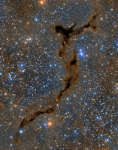 Dark Seahorse in Cepheus
24.10.2019
Light-years across, this suggestive shape known as the Seahorse Nebula appears in silhouette against a rich, luminous background of stars. Seen toward the royal northern constellation of Cepheus, the dusty, obscuring clouds are part of a Milky Way molecular cloud some 1,200 light-years distant.
 The Dark Seahorse in Cepheus
5.11.2021
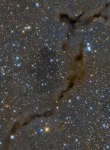
Light-years across, this suggestive shape known as the Seahorse Nebula appears in silhouette against a rich, luminous background of stars. Seen toward the royal northern constellation of Cepheus, the dusty, obscuring clouds are part of a Milky Way molecular cloud some 1,200 light-years distant.
|
January February March April May June July August September October |
|||||||||||||||||||||||||||||||||||||||||||||||||