
|
You entered: Earth orbit
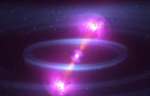 GW170817: A Spectacular Multiradiation Merger Event Detected
16.10.2017
Both gravitational and electromagnetic radiations have been detected in rapid succession for an explosive merging event for the first time. Data from the outburst fit well with a spectacular binary neutron-star death-spiral. The explosive episode was seen on August 17 in nearby NGC 4993, an elliptical galaxy only 130 million light years distant.
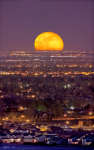 Full Moonrise
5.05.2012
Rising as the Sun sets, tonight's Full Moon could be hard to miss. Remarkably, its exact full phase (May 6 03:36 UT) will occur less than two minutes after it reaches perigee, the closest point to Earth in the Moon's orbit, making it the largest Full Moon of 2012.
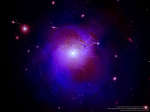 Unexpected X Rays from Perseus Galaxy Cluster
2.01.2018
Why does the Perseus galaxy cluster shine so strangely in one specific color of X-rays? No one is sure, but a much-debated hypothesis holds that these X-rays are a clue to the long-sought identity of dark matter.
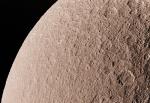 Rhea: Saturn's Second Largest Moon
8.06.2003
Rhea is the second largest moon of Saturn, behind Titan, and the largest without an atmosphere. It is composed mostly of water ice, but has a small rocky core. Rhea's rotation and orbit are locked together (just like Earth's Moon) so that one side always faces Saturn.
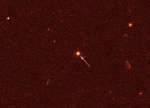 The GRB 110328A Symphony
19.04.2011
A symphony of planet-wide observations began abruptly on March 28 when the Earth-orbiting Swift satellite detected a burst of high-frequency gamma-rays from GRB 110328A. When the same source flared again after a 45 minute pause it was clear this event was not a typical gamma-ray burst.
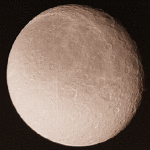 Rhea: Saturn's Second Largest Moon
14.10.1995
Rhea is the second largest moon of Saturn, behind Titan, and the largest without an atmosphere. It is composed mostly of water ice, but has a small rocky core. Rhea's rotation and orbit are locked together (just like Earth's Moon) so that one side always faces Saturn.
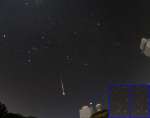 Leonid Fireball over Tenerife
22.11.2011
Historically active, this year's Leonid meteor shower was diminished by bright moonlight. Still, faithful night sky watchers did see the shower peak on November 18 and even the glare of moonlight didn't come close to masking this brilliant fireball meteor.
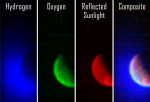 MAVEN at Mars
26.09.2014
Launched on November 18, 2013, the MAVEN (Mars Atmosphere and Volatile EvolutioN) spacecraft completed its interplanetary voyage September 21, captured into a wide, elliptical orbit around Mars. MAVEN's imaging ultraviolet spectrograph has already...
 An ALMA Telescope Array Time Lapse
26.05.2014
It is the most expensive and complex ground-based astronomy project ever -- what will it see tonight? The Atacama Large Millimeter Array (ALMA) project consists of 66 dishes, many the size of a small house, situated in the high altitude Atacama Desert in Northern Chile.
 The Perseid Meteor Shower
9.08.1996
From a radiant point in the constellation of Perseus, Comet Swift-Tuttle presents -- The Perseid Meteor Shower -- coming to your night sky this weekend! A bookish E. C. Herrick of New Haven, Connecticut correctly suspected in 1837 that this meteor shower was an annual event.
|
January February March April May June July August September October |
|||||||||||||||||||||||||||||||||||||||||||||||||