
|
You entered: hot gas
 APOD: 2024 April 15 Б The Cigar Galaxy from Hubble and Webb
15.04.2024
Something strange happened to this galaxy, but what? Known as the Cigar Galaxy and cataloged as M82, red glowing gas and dust are being cast out from the center. Although this starburst galaxy...
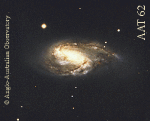 Unusual Spiral Galaxy M66
10.08.1996
Spiral galaxy M66 is largest galaxy in the a group known as the Leo Triplet. M66 is somewhat peculiar because of its asymmetric spiral arms. Usually dense waves of gas, dust, and newly formed stars - called spiral density waves - circle a galactic center and create a symmetric galaxy.
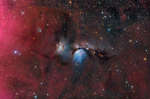 M78 Wide Field
29.12.2017
Interstellar dust clouds and glowing nebulae abound in the fertile constellation of Orion. One of the brightest, M78, is centered in this colorful, wide field view, covering an area north of Orion's belt. At a distance of about 1,500 light-years, the bluish reflection nebula is around 5 light-years across.
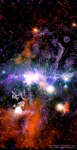 The Galactic Center in Stars, Gas, and Magnetism
2.06.2021
What's going on near the center of our galaxy? To help find out, a newly detailed panorama has been composed that explores regions just above and below the galactic plane in radio and X-ray light.
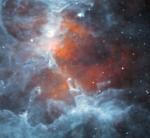 Cold Dust in the Eagle Nebula
14.09.2001
Stars are born in M16's Eagle Nebula, a stellar nursery 7,000 light-years from Earth toward the constellation Serpens. The striking nebula's star forming pillars of gas and dust are familiar to astronomers from images at visible wavelengths, but this false-color picture shows off the nebula in infrared light.
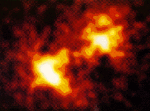 An X-ray Hot Supernova in M81
3.12.1995
In 1993, a star in the galaxy M81 exploded. Above is a picture of the hot material ejected by this supernova explosion. The picture was taken in X-rays with the Advanced Satellite for Cosmology and Astrophysics (ASCA).
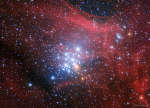 NGC 3293: A Bright Young Star Cluster
6.04.2015
Hot blue stars shine brightly in this beautiful, recently formed galactic or "open" star cluster. Open cluster NGC 3293 is located in the constellation Carina, lies at a distance of about 8000 light years, and has a particularly high abundance of these young bright stars.
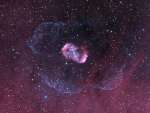 A Halo for NGC 6164
27.10.2012
Beautiful emission nebula NGC 6164 was created by a rare, hot, luminous O-type star, some 40 times as massive as the Sun. Seen at the center of the cosmic cloud, the star is a mere 3 to 4 million years old.
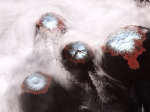 Islands of Four Mountains from Above
22.06.2010
Our Earth is covered by volcanoes. Volcanoes are breaks in the Earth's cool surface where hot liquid rock from the interior comes out -- sometimes suddenly. In the above image from the ASTER camera...
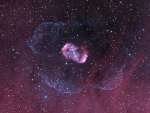 A Halo for NGC 6164
7.05.2009
Beautiful emission nebula NGC 6164 was created by a rare, hot, luminous O-type star, some 40 times as massive as the Sun. Seen at the center of the cosmic cloud, the star is a mere 3 to 4 million years old.
|
January February March April May June July August |
||||||||||||||||||||||||||||||||||||||||||||||||||||||||