
|
You entered: Earth orbit
 APOD: 2023 August 8 Б Moon Meets Jupiter
7.08.2023
What's that below the Moon? Jupiter -- and its largest moons. Many skygazers across planet Earth enjoyed the close conjunction of Earth's Moon passing nearly in front of Jupiter in mid-June. The featured image is a single exposure of the event taken from MorцЁn de la Frontera, Spain.
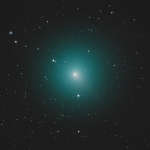 Comet 46P Wirtanen
14.11.2018
Periodic Comet 46P/Wirtanen is now the brightest comet in the night sky, but too faint to be seen by eye. From dark sky sites it could just become naked-eye visible though, as it's 5.4 year long looping orbit takes it closest to Earth and the Sun in mid December.
 APOD: 2024 August 4 Б Gaia: Here Comes the Sun
3.08.2024
What would it look like to return home from outside our galaxy? Although designed to answer greater questions, data from ESA's robotic Gaia mission is helping to provide a uniquely modern perspective on humanity's place in the universe.
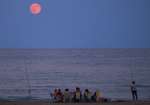 Alicante Beach Moonrise
19.07.2014
In this beach and skyscape from Alicante, Spain, July's Full Moon shines in the dark blue twilight, its reflection coloring the Mediterranean waters. Near the horizon, the moonlight is reddened by its long...
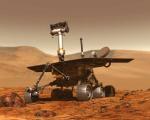 Name This Martian Robot
25.11.2002
NASA will launch two robots to Mars next year and you can help name them. The Mars Exploration Rovers are scheduled for launch on or near this coming June, when Mars and Earth are relatively close in their orbits.
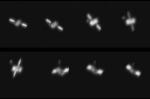 Compton Returns
6.03.2001
On 2000 June 4, the 17-ton Compton Gamma-Ray Observatory returned to Earth after 9 years in orbit -- ending its remarkable voyage of discovery. The massive, bus-sized spacecraft carried an unprecedented array of gamma-ray detectors which explored the bizarre, high-energy universe of solar flares, black holes, pulsars, supernovae, active galaxies, and gamma-ray bursts.
 Kepler Discovers How Planets Move
13.09.1997
Johannes Kepler used simple mathematics to describe how planets move. Kepler was an assistant to the most accurate astronomical observer of the time, Tycho Brahe. Kepler was able to use Brahe's data...
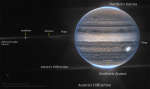 Jupiter from the Webb Space Telescope
29.08.2022
This new view of Jupiter is illuminating. High-resolution infrared images of Jupiter from the new James Webb Space Telescope (Webb) reveal, for example, previously unknown differences between high-floating bright clouds -- including the Great Red Spot -- and low-lying dark clouds.
 Kepler Discovers How Planets Move
31.08.1996
Johannes Kepler used simple mathematics to describe how planets move. Kepler was an assistant to the most accurate astronomical observer of the time, Tycho Brahe. Kepler was able to use Brahe's data...
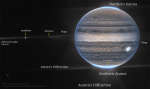 APOD: 2026 January 18 Б Jupiter from the Webb Space Telescope
17.01.2026
This infrared view of Jupiter by Webb is illuminating. High-resolution infrared images of Jupiter from the James Webb Space Telescope (Webb) reveal, for example, differences between high-floating bright clouds -- including the Great Red Spot -- and low-lying dark clouds.
|
January February March April May June July August September October |
|||||||||||||||||||||||||||||||||||||||||||||||||