
|
You entered: massive stars
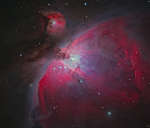 At the Heart of Orion
12.03.2017
Near the center of this sharp cosmic portrait, at the heart of the Orion Nebula, are four hot, massive stars known as the Trapezium. Tightly gathered within a region about 1.5 light-years in radius, they dominate the core of the dense Orion Nebula Star Cluster.
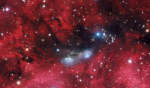 The NGC 6914 Complex
30.08.2018
A study in contrasts, this colorful skyscape features stars, dust, and glowing gas in the vicinity of NGC 6914. The complex of reflection nebulae lies some 6,000 light-years away, toward the high-flying northern constellation Cygnus and the plane of our Milky Way Galaxy.
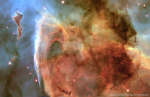 The Keyhole in the Carina Nebula
14.08.2016
The dark dusty Keyhole Nebula gets its name from its unusual shape. The looping Keyhole, in this featured classic image by the Hubble Space Telescope, is a smaller region inside the larger Carina Nebula.
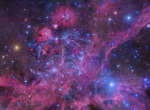 Vela Supernova Remnant Mosaic
10.01.2019
The plane of our Milky Way Galaxy runs through this complex and beautiful skyscape. Seen toward colorful stars near the northwestern edge of the constellation Vela (the Sails), the 16 degree wide, 200 frame...
 Cone Nebula Close Up
3.05.2002
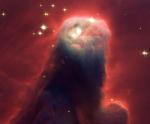
Cones, pillars, and majestic flowing shapes abound in stellar nurseries where natal clouds of gas and dust are buffeted by energetic winds from newborn stars. A well-known example, the Cone Nebula within the bright galactic star-forming region NGC 2264, was captured in this close-up view from the Hubble Space Telescope's newest camera.
 The Nebula And The Neutron Star
1.02.2003
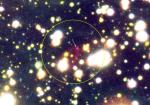
The lonely RX J1856.5-3754 was formed from the collapsed core of an exploding star. At a distance of 180 light-years it is the closest known neutron star. More massive than...
 Star Cluster NGC 362 from Hubble
11.10.2017
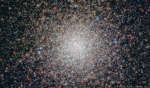
If our Sun were near the center of NGC 362, the night sky would glow like a jewel box of bright stars. Hundreds of stars would glow brighter than Sirius, and in many different colors.
 At the Heart of Orion
6.10.2012
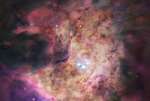
Near the center of this sharp cosmic portrait, at the heart of the Orion Nebula, are four hot, massive stars known as the Trapezium. Gathered within a region about 1.5 light-years in radius, they dominate the core of the dense Orion Nebula Star Cluster.
 NGC 6888: The Crescent Nebula
17.06.2021
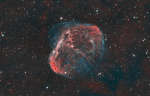
NGC 6888, also known as the Crescent Nebula, is a about 25 light-years across blown by winds from its central, bright, massive star. A triumvirate of astroimagers ( Joe, Glenn, Russell) created this sharp portrait of the cosmic bubble.
 NGC 3572 and the Southern Tadpoles
6.05.2022
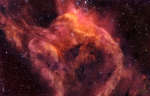
This cosmic skyscape features glowing gas and dark dust clouds along side the young stars of NGC 3572. A beautiful emission nebula and star cluster it sails far southern skies within the nautical constellation Carina.
|
January February March April |
|||||||||||||||||||||||||||||||||||||||||||||||||