
|
You entered: ring galaxy
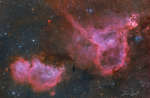 APOD: 2023 February 14 Б The Heart and Soul Nebulas
14.02.2023
Is the heart and soul of our Galaxy located in Cassiopeia? Possibly not, but that is where two bright emission nebulas nicknamed Heart and Soul can be found. The Heart Nebula, officially dubbed IC 1805 and visible in the featured image on the upper right, has a shape reminiscent of a classical heart symbol.
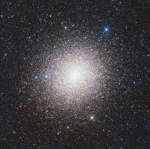 Globular Star Cluster 47 Tuc
10.03.2022
Globular star cluster 47 Tucanae is a jewel of the southern sky. Also known as NGC 104, it roams the halo of our Milky Way Galaxy along with some 200 other globular star clusters. The second brightest globular cluster (after Omega Centauri) as seen from planet Earth, 47 Tuc lies about 13,000 light-years away.
 Globular Star Cluster 47 Tuc
8.02.2024
Globular star cluster 47 Tucanae is a jewel of the southern sky. Also known as NGC 104, it roams the halo of our Milky Way Galaxy along with some 200 other globular star clusters. The second brightest globular cluster (after Omega Centauri) as seen from planet Earth, 47 Tuc lies about 13,000 light-years away.
 Keck: The Largest Optical Telescopes
27.12.1997
In buildings eight stories tall rest mirrors ten meters across that are slowly allowing humanity to map the universe. Alone, each is the world's largest optical telescope: Keck. Together, the twin Keck telescopes have the resolving power of a single telescope 90-meter in diameter, able to discern sources just milliarcseconds apart.
 APOD: 2025 June 3 Б Rainbow Airglow over the Azores
3.06.2025
Why would the sky glow like a giant repeating rainbow? Airglow. Now, air glows all of the time, but it is usually hard to see. A disturbance however -- like an approaching storm -- may cause noticeable rippling in the Earth's atmosphere.
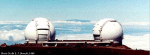 Keck: The Largest Optical Telescope
15.07.1996
In buildings eight stories tall rest mirrors ten meters across that are slowly allowing humanity to map the universe. Alone, each is the world's largest optical telescope: Keck. Together, the twin Keck telescopes have the resolving power of a single telescope 90-meter in diameter, able to discern sources just milliarcseconds apart.
 SNR 0104: An Unusual Suspect
12.06.2009
SNR 0104 is a supernova remnant with an unusual shape. Found 190,000 light-years away in our neighboring galaxy the Small Magellanic Cloud, SNR 0104 is suspected of being the expanding debris cloud from a Type 1a supernova - the catastrophic thermonuclear explosion of a white dwarf star.
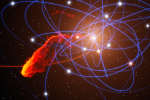 The Diner at the Center of the Galaxy
30.12.2011
The monster at the center of our Galaxy is about to get fed. Recent observations by the Very Large Telescopes indicate that a cloud of gas will venture too close to the supermassive black hole at the Galactic center.
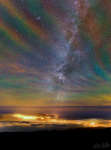 Rainbow Airglow over the Azores
18.04.2021
Why would the sky glow like a giant repeating rainbow? Airglow. Now air glows all of the time, but it is usually hard to see. A disturbance however -- like an approaching storm -- may cause noticeable rippling in the Earth's atmosphere.
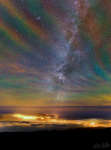 Rainbow Airglow over the Azores
22.03.2016
Why would the sky glow like a giant repeating rainbow? Airglow. Now air glows all of the time, but it is usually hard to see. A disturbance however -- like an approaching storm -- may cause noticeable rippling in the Earth's atmosphere.
|
January February March April May June July August September October |
|||||||||||||||||||||||||||||||||||||||||||||||||