
|
You entered: water
 The Nebula And The Neutron Star
1.02.2003
The lonely RX J1856.5-3754 was formed from the collapsed core of an exploding star. At a distance of 180 light-years it is the closest known neutron star. More massive than...
 A Sudden Jet on Comet 67P?
18.11.2015
There she blows! A dramatic demonstration of how short-lived some comet jets can be was documented in late July by the robotic Rosetta spacecraft orbiting the nucleus of Comet 67P/Churyumov-Gerasimenko. The featured animation depicts changes in the rotating comet with three illuminating stills.
 APOD: 2024 March 25 Б Sonified: The Jellyfish Nebula Supernova Remnant
25.03.2024
What does a supernova remnant sound like? Although sound is a compression wave in matter and does not carry into empty space, interpretive sound can help listeners appreciate and understand a visual image of a supernova remnant in a new way. Recently, the Jellyfish Nebula (IC 443) has been sonified quite creatively.
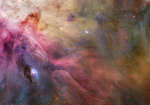 LL Ori and the Orion Nebula
3.02.2013
This esthetic close-up of cosmic clouds and stellar winds features LL Orionis, interacting with the Orion Nebula flow. Adrift in Orion's stellar nursery and still in its formative years, variable star LL Orionis produces a wind more energetic than the wind from our own middle-aged Sun.
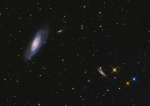 A View Toward M106
1.05.2020
Big, bright, beautiful spiral, Messier 106 dominates this cosmic vista. The nearly two degree wide telescopic field of view looks toward the well-trained constellation Canes Venatici, near the handle of the Big Dipper. Also...
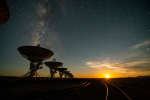 The Very Large Array at Moonset
9.10.2020
An inspirational sight, these giant dish antennas of the Karl G. Jansky Very Large Array (VLA) rise above the New Mexico desert at moonset. Mounted on piers but transportable on railroad tracks to change...
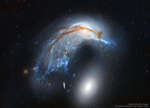 The Porpoise Galaxy from Hubble
6.02.2017
What's happening to this spiral galaxy? Just a few hundred million years ago, NGC 2936, the upper of the two large galaxies shown, was likely a normal spiral galaxy -- spinning, creating stars -- and minding its own business.
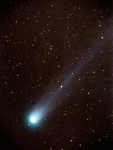 What are Comet Tails Made Of?
26.03.1996
The tail of comet Hyakutake, visible in this recent color image, is composed of dust and gas driven off the icy comet nucleus by the Sun's heat and blown away by the solar wind. Bathed in solar ultraviolet light, the gas molecules break down and are excited, producing a characteristic glow.
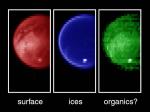 Titan from Cassini in Infrared
6.07.2004
Could life exist under the smog of Titan? If not, what is creating all of the methane? To help answer these questions, the largest and most mysterious moon of Saturn got a quick first look from the Cassini robot spacecraft soon after entering orbit around the giant planet last week.
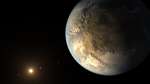 Earth size Kepler 186f
19.04.2014
Planet Kepler-186f is the first known Earth-size planet to lie within the habitable zone of a star beyond the Sun. Discovered using data from the prolific planet-hunting Kepler spacecraft, the distant world orbits...
|
January February March April May June July August September October |
|||||||||||||||||||||||||||||||||||||||||||||||||