
|
You entered: Ring Nebula
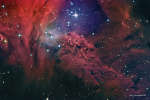 The Fox Fur Nebula
30.12.2015
This interstellar canine is formed of cosmic dust and gas interacting with the energetic light and winds from hot young stars. The shape, visual texture, and color, combine to give the region the popular name Fox Fur Nebula.
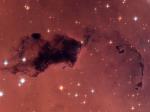 A Dust Cloud in NGC 281
20.04.2006
Stars themselves can create huge and intricate dust sculptures from the dense and dark molecular clouds from which they are born. The tools the stars use to carve their detailed works are high energy light and fast stellar winds.
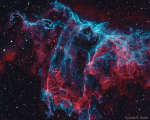 NGC 6995: The Bat Nebula
25.11.2019
Do you see the bat? It haunts this cosmic close-up of the eastern Veil Nebula. The Veil Nebula itself is a large supernova remnant, the expanding debris cloud from the death explosion of a massive star.
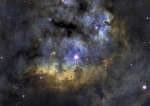 NGC 7822 in Cepheus
16.11.2011
Hot, young stars and cosmic pillars of gas and dust seem to crowd into NGC 7822. At the edge of a giant molecular cloud toward the northern constellation Cepheus, the glowing star forming region lies about 3,000 light-years away. Within the nebula, bright edges and dark shapes are highlighted in this colorful skyscape.
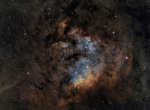 NGC 7822 in Cepheus
23.05.2015
Hot, young stars and cosmic pillars of gas and dust seem to crowd into NGC 7822. At the edge of a giant molecular cloud toward the northern constellation Cepheus, the glowing star forming region lies about 3,000 light-years away. Within the nebula, bright edges and dark shapes are highlighted in this colorful skyscape.
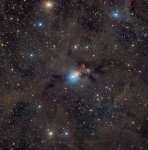 Stardust in the Perseus Molecular Cloud
18.03.2021
Clouds of stardust drift through this deep skyscape, across the Perseus molecular cloud some 850 light-years away. Dusty nebulae reflecting light from embedded young stars stand out in the nearly 2 degree wide telescopic field of view.
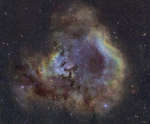 NGC 7822 in Cepheus
11.11.2016
Hot, young stars and cosmic pillars of gas and dust seem to crowd into NGC 7822. At the edge of a giant molecular cloud toward the northern constellation Cepheus, the glowing star forming region lies about 3,000 light-years away. Within the nebula, bright edges and dark shapes stand out in this colorful skyscape.
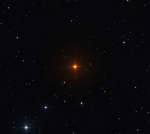 R Leporis: A Vampire's Star
31.10.2018
Better known as Hind's Crimson Star, R Leporis is a rare star in planet Earth's night sky. It's also a shocking shade of red. The star's discoverer, 19th century English...
 The Snake Nebula in Ophiuchus
11.08.1996
What slithers there? The dark curly lanes visible in part of the constellation Ophiuchus belong to the Snake Nebula. The Snake Nebula is a series of dark absorption clouds. Interstellar dust grains - composed predominantly of carbon - absorb visible starlight and reradiate much of it in the infrared.
 In the Center of the Dumbbell Nebula
13.10.1998
Here's part of the Dumbbell Nebula that you can't see through binoculars. To see this, we suggest a sophisticated spectrograph attached to a telescope with an 8-meter aperture. Pictured above is the central part of the Dumbbell Nebula, also known as M27 and NGC 6853.
|
January February March April May June July August September October |
|||||||||||||||||||||||||||||||||||||||||||||||||