
|
You entered: atmosphere
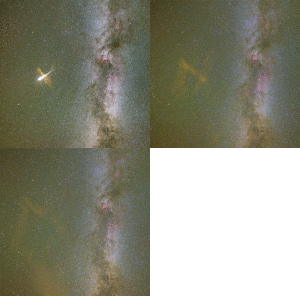 Milky Way and Exploding Meteor
12.08.2015
Tonight the Perseid Meteor Shower reaches its maximum. Grains of icy rock will streak across the sky as they evaporate during entry into Earth's atmosphere. These grains were shed from Comet Swift-Tuttle.
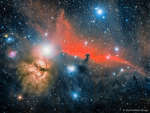 The Horsehead Nebula
16.12.2015
The Horsehead Nebula is one of the most famous nebulae on the sky. It is visible as the dark indentation to the red emission nebula in the center of the above photograph. The horse-head feature is dark because it is really an opaque dust cloud that lies in front of the bright red emission nebula.
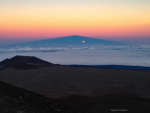 Full Moon in Mountain Shadow
21.10.2016
On October 15, standing near the summit of Hawaii's Mauna Kea and looking away from a gorgeous sunset produced this magnificent snapshot of a Full Moon rising within the volcanic mountain's shadow. An alignment across the Solar System is captured in the stunning scene and seeming contradiction of bright Moon in dark shadow.
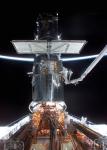 SM3B: Mission to Hubble
14.03.2002
Now complete, Servicing Mission 3B (SM3B) was really the fourth trip to the Hubble Space Telescope, as the originally planned mission 3 was split into two parts. Falling around planet Earth, about 320 nautical...
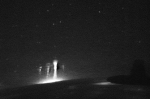 Blue Jet Lightning
12.11.1995
Recently two new types of lightning have been verified: red sprites and blue jets. These atmospheric discharges occur very high in the Earth's atmosphere - much higher than the familiar form of lightning. Blue jets appear blue in color and go from the tops of clouds to a height of about 50 kilometers.
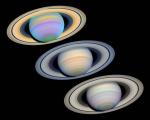 Saturn by Three
18.09.2003
These three views of Saturn were recorded by the Hubble Space Telescope on March 7th of this year, as the southern hemisphere of the solar system's most gorgeous planet reached its maximum 27 degree tilt toward Earth.
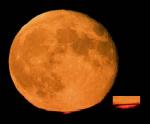 Orange Moon, Red Flash
22.09.2005
This remarkable telescopic image highlights the deep orange cast of a waning gibbous Moon seen very close to the eastern horizon earlier this week, on September 19. In fact, today's equinox...
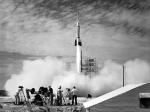 The First Rocket Launch from Cape Canaveral
4.06.2006
A new chapter in space flight began on 1950 July with the launch of the first rocket from Cape Canaveral, Florida: the Bumper 2. Shown above, the Bumper 2 was an ambitious two-stage rocket program that topped a V-2 missile base with a WAC Corporal rocket.
 Unexpected Impact on Jupiter
8.09.2009
Two months ago, something unexpected hit Jupiter. First discovered by an amateur astronomer Anthony Wesley on 2009 July 19, the impact was quickly confirmed and even imaged by the Hubble Space Telescope the very next day.
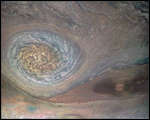 North North Temperate Zone Little Red Spot
4.08.2017
On July 11, the Juno spacecraft once again swung near the turbulent Jovian cloud tops. On its seventh orbital closest approach this perijove passage brought Juno within 3,500 kilometers of the Solar System's largest planetary atmosphere.
|
January February March April May June July August September October |
|||||||||||||||||||||||||||||||||||||||||||||||||