
|
You entered: young stars
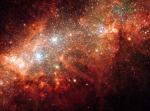 NGC 1569: Starburst in a Small Galaxy
5.02.2004
Grand spiral galaxies often seem to get all the glory, flaunting their young, bright, blue star clusters in beautiful, symmetric spiral arms. But small, irregular galaxies form stars too. In fact, as pictured here...
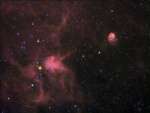 The Spider and the Fly
13.01.2010
Bright clusters and nebulae abound in the ancient northern constellation of Auriga. The region includes the open star cluster M38, emission nebula IC 410 with Tadpoles, Auriga's own Flaming Star Nebula IC 405, and this interesting pair IC 417 (lower left) and NGC 1931.
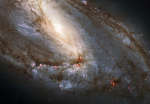 Messier 66 Close Up
13.06.2024
Big, beautiful spiral galaxy Messier 66 lies a mere 35 million light-years away. The gorgeous island universe is about 100 thousand light-years across, similar in size to the Milky Way. This Hubble Space Telescope close-up view spans a region about 30,000 light-years wide around the galactic core.
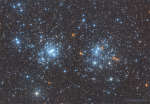 A Double Star Cluster in Perseus
22.11.2022
Few star clusters this close to each other. Visible to the unaided eye from dark sky areas, it was cataloged in 130 BC by Greek astronomer Hipparchus. Some 7,000 light-years away, this pair...
 Runaway Star Alpha Camelopardalis
28.04.2023
Like a ship plowing through cosmic seas, runaway star Alpha Camelopardalis has produced this graceful arcing bow wave or bow shock. The massive supergiant star moves at over 60 kilometers per second through space, compressing the interstellar material in its path.
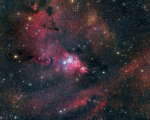 Cosmic Clouds in the Unicorn
8.02.2020
Interstellar clouds of hydrogen gas and dust abound in this gorgeous skyscape. The 3 degree wide field of view stretches through the faint but fanciful constellation Monoceros, the Unicorn. A star forming region cataloged as NGC 2264 is centered, a complex jumble of cosmic gas, dust and stars about 2,700 light-years distant.
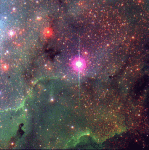 Starbirth in the Lagoon Nebula
24.10.1996
Stars are forming even today in the Lagoon Nebula. This bright nebula is visible in the constellation of Sagittarius with binoculars. The above photo is the result of a new sensitive camera being attached to one of the world's largest telescopes.
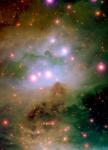 The Colorful Orion Nebula
14.09.1999
The Great Nebula in Orion is a colorful place. Visible to the unaided eye as a fuzzy patch in the constellation of Orion, this image taken with the Big Throughput Camera shows the Orion Nebula to be a busy neighborhood of young stars, hot gas, and dark dust.
 APOD: 2025 February 11 Б The Spider and the Fly
11.02.2025
Will the spider ever catch the fly? Not if both are large emission nebulas toward the constellation of the Charioteer (Auriga). The spider-shaped gas cloud in the image center is actually an emission nebula...
 Orion Nebula in Oxygen, Hydrogen, and Sulfur
13.07.2004
The Great Nebula in Orion, an immense, nearby starbirth region, is arguably the most famous of all astronomical nebulae. The Orion Nebula, also known as M42, is shown above through ultraviolet and blue filters augmented with three exact colors specifically emitted by hydrogen, oxygen, and sulfur.
|
January February March April May June July August September October |
|||||||||||||||||||||||||||||||||||||||||||||||||