
|
You entered: Solar System
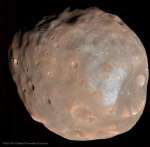 APOD: 2026 January 25 Б Phobos: Doomed Moon of Mars
25.01.2026
This moon is doomed. Mars, the red planet named for the Roman god of war, has two tiny moons, Phobos and Deimos, whose names are derived from the Greek for Fear and Panic. These...
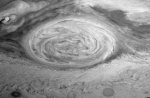 Galileo, Cassini, and the Great Red Spot
2.08.1996
Imagine a hurricane that lasted for 300 years! Jupiter's Great Red Spot indeed seems to be a giant hurricane-like storm system rotating with the Jovian clouds. Observed in 1655 by Italian-French astronomer Jean-Dominique Cassini it is seen here over 300 years later - still going strong - in a mosaic of recent Galileo spacecraft images.
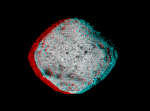 3D Bennu
13.12.2018
Put on your red/blue glasses and float next to asteroid 101955 Bennu. Shaped like a spinning top toy with boulders littering its rough surface, the tiny Solar System world is about 1 Empire State Building (less than 500 meters) across.
 Comet at Moonrise
4.10.2024
Comet C/2023 A3 (TsuchinshanБATLAS) is growing brighter in planet Earth's sky. Fondly known as comet A3, this new visitor to the inner Solar System is traveling from the distant Oort cloud. The comet...
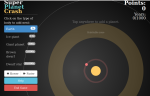 Game: Super Planet Crash
19.06.2022
Can you create a planetary system that lasts for 1000 years? Super Planet Crash, the featured game, allows you to try. To create up to ten planets, just click anywhere near the central star.
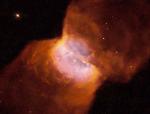 NGC 2346: A Butterfly-Shaped Planetary Nebula
28.10.2001
It may look like a butterfly, but it's bigger than our Solar System. NGC 2346 is a planetary nebula made of gas and dust that has evolved into a familiar shape. At the heart of the bipolar planetary nebula is a pair of close stars orbiting each other once every sixteen days.
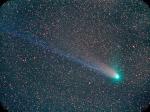 The Tails of Comet NEAT Q4
12.05.2004
Comet NEAT (Q4) is showing its tails. As the large snowball officially dubbed Comet C/2001 Q4 (NEAT) falls toward the inner Solar System, it has already passed the Earth and will reach its closest approach to the Sun this coming Saturday.
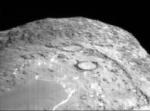 The Landscape on Comet Tempel 1
6.07.2005
This diverse landscape is the surface of comet Temple 1's nucleus as seen by the Deep Impact probe's Impactor Targeting Sensor. Within minutes of recording the rugged view, the landscape had changed dramatically though, as the impactor smashed into the surface near the two large, half kilometer-sized craters at picture center.
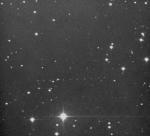 Cassini Flyby
26.08.1999
Connect the dots and you'll trace the path of the Cassini spacecraft as it took a final turn by Earth on its way to the outer solar system. The dots (in a horizontal row just below center) are actually successive images of the spacecraft.
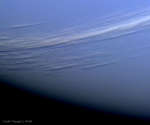 Two Hours Before Neptune
14.02.2015
Two hours before closest approach to Neptune in 1989, the Voyager 2 robot spacecraft snapped this picture. Clearly visible for the first time were long light-colored cirrus-type clouds floating high in Neptune's atmosphere. Shadows of these clouds can even be seen on lower cloud decks.
|
January February March April May June July August |
||||||||||||||||||||||||||||||||||||||||||||||||||||||||