
|
You entered: Jupiter
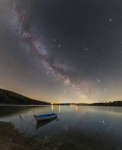 Lyrid Meteors from the Constellation Lyra
12.05.2020
Where are all of these meteors coming from? In terms of direction on the sky, the pointed answer is the constellation of Small Harp (Lyra). That is why the famous meteor shower that peaks every April is known as the Lyrids -- the meteors all appear to came from a radiant toward Lyra.
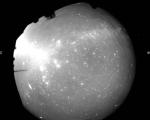 Zodiacal Light and the False Dawn
12.09.2001
An unusual triangle of light will be particularly bright near the eastern horizon before sunrise during the next two months for observers in Earth's northern hemisphere. Once considered a false dawn, this triangle of light is actually Zodiacal Light, light reflected from interplanetary dust particles.
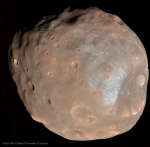 Phobos: Doomed Moon of Mars
22.11.2015
This moon is doomed. Mars, the red planet named for the Roman god of war, has two tiny moons, Phobos and Deimos, whose names are derived from the Greek for Fear and Panic. These...
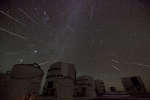 When Gemini Sends Stars to Paranal
13.12.2015
From a radiant point in the constellation of the Twins, the annual Geminid meteor shower rain down on planet Earth. Tonight, the Geminds reach their peak and could be quite spectacular. The featured blended image, however, captured the shower's impressive peak in the year 2012.
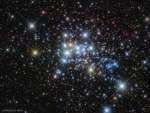 The Massive Stars in Westerlund 1
20.06.2017
Star cluster Westerlund 1 is home to some of the largest and most massive stars known. It is headlined by the star Westerlund 1-26, a red supergiant star so big that if placed in the center of our Solar System, it would extend out past the orbit of Jupiter.
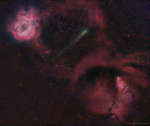 Comet 12P Between Rosette and Cone Nebulas
8.10.2018
Small bits of this greenish-gray comet are expected to streak across Earth's atmosphere tonight. Specifically, debris from the eroding nucleus of Comet 21P / Giacobini-Zinner, pictured, causes the annual Draconids meteor shower, which peaks this evening.
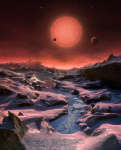 Three Worlds for TRAPPIST 1
7.05.2016
Three new found worlds orbit the ultracool dwarf star TRAPPIST-1, a mere 40 light-years away. Their transits were first detected by the Belgian robotic TRAnsiting Planets and Planetesimals Small Telescope, TRAPPIST, at ESO's La Silla Observatory in Chile. The newly discovered exoplanets are all similar in size to Earth.
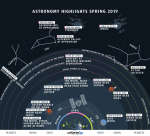 Highlights of the North Spring Sky
13.03.2019
What can you see in the night sky this season? The featured graphic gives a few highlights for Earth's northern hemisphere. Viewed as a clock face centered at the bottom, early (northern) spring sky events fan out toward the left, while late spring events are projected toward the right.
 Solar System Portrait
14.02.2002
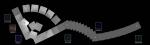
On another Valentine's Day (February 14, 1990), cruising four billion miles from the Sun, the Voyager 1 spacecraft looked back to make this first ever family portrait of our Solar System. The complete portrait is a 60 frame mosaic made from a vantage point 32 degrees above the ecliptic plane.
 Phobos: Doomed Moon of Mars
31.05.1998
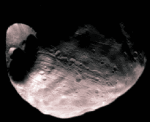
Phobos is doomed. Mars, the red planet named for the Roman god of war, has two tiny moons, Phobos and Deimos, whose names are derived from the Greek for Fear and Panic. These Martian...
|
January February March April May June July August September October |
|||||||||||||||||||||||||||||||||||||||||||||||||