
|
You entered: Saturn
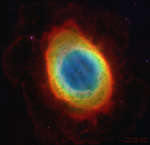 M57: The Ring Nebula from Hubble
17.08.2021
Except for the rings of Saturn, the Ring Nebula (M57) is probably the most famous celestial circle. Its classic appearance is understood to be due to our own perspective, though. The recent mapping...
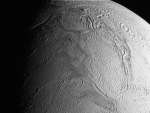 Cassini Passes Through Ice Plumes of Enceladus
13.10.2008
What telling impurities taint the ice plumes of Enceladus? To help answer this question, the robotic Cassini spacecraft dove last week to within 30 kilometers of Saturn's ice-plume emitting moon. At this closest-ever...
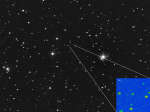 Introducing Comet ISON
1.10.2012
Could this dim spot brighten into one of the brightest comets ever? It's possible. Alternatively, the comet could break up when it gets closer to the Sun, or brighten much more modestly.
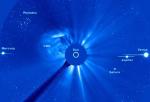 Pleiades, Planets, And Hot Plasma
24.05.2000
Bright stars of the Pleiades, four planets, and erupting solar plasma are all captured in this spectacular image from the space-based SOlar and Heliospheric Observatory (SOHO). In the foreground of the 15 degree wide field of view, a bubble of hot plasma, called a Coronal Mass Ejection (CME)
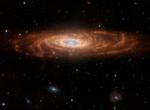 NGC 7331: A Galaxy So Inclined
1.07.2004
If our own Milky Way galaxy were 50 million light-years away with its disk inclined slightly to our line of sight, it would look a lot like large spiral galaxy NGC 7331. In fact...
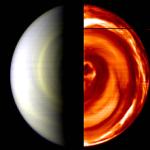 Swirling Clouds Over the South Pole of Venus
1.05.2007
What's happening over the South Pole of Venus? To find out, scientists sent the robot Venus Express spacecraft now orbiting Venus directly over the lower spin axis of Earth's overheated twin. Venus Express confirmed there a spectacular massive swirling storm system with similarities to the vortex recently imaged over Saturn's South Pole.
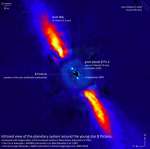 A Giant Planet for Beta Pic
3.07.2010
A mere 50 light-years away, young star Beta Pictoris became one of the most important stars in the sky in the early 1980s. Satellite and ground-based telescopic observations revealed the presence of a surrounding...
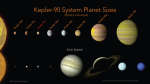 The Kepler 90 Planetary System
18.12.2017
Do other stars have planetary systems like our own? Yes -- one such system is Kepler-90. Cataloged by the orbiting Kepler satellite, an eighth planet has now been discovered giving Kepler-90 the same number of known planets as our Solar System.
 Solar System Family Portrait
13.07.2024
In 1990, cruising four billion miles from the Sun, the Voyager 1 spacecraft looked back to make this first ever Solar System family portrait. The complete portrait is a 60 frame mosaic made from a vantage point 32 degrees above the ecliptic plane.
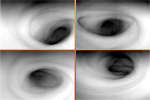 Venus South Polar Vortex
28.09.2010
What's happening over the South Pole of Venus? To find out, scientists have been studying images taken by the robotic Venus Express spacecraft when it passes over the lower spin axis of Earth's overheated twin.
|
January February March April May June July August September October |
|||||||||||||||||||||||||||||||||||||||||||||||||