
|
You entered: space
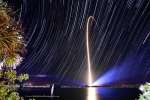 Rocket Streak and Star Trails
30.01.2014
Fixed to a tripod and looking east across the Kennedy Space Center's Turn Basin, a camera captured these star trails as a series of short exposures over a three hour period on the evening of January 23rd.
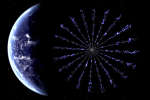 Heliopause Electrostatic Rapid Transit System
16.04.2016
Want to take a fast trip to the edge of the Solar System? Consider a ride on a Heliopause Electrostatic Rapid Transit System (HERTS). The concept is currently being tested and it might take only 10 to 15 years to make the trip of over 100 Astronomical Units (15 billion kilometers).
 Elliptical M60, Spiral NGC 4647
14.09.2012
Giant elliptical galaxy M60 and spiral galaxy NGC 4647 do look like an odd couple in this sharp cosmic portrait from the Hubble Space Telescope. But they are found in a region of space where galaxies tend to gather, on the eastern side of the nearby Virgo Galaxy Cluster.
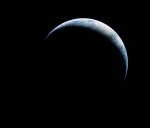 Apollo 17: The Crescent Earth
29.04.2021
Our fair planet sports a curved, sunlit crescent against the black backdrop of space in this stunning photograph. From the unfamiliar perspective, the Earth is small and, like a telescopic image of a distant planet, the entire horizon is completely within the field of view.
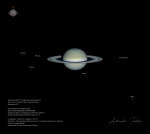 APOD: 2026 August 11 Б Six Moons of Saturn
11.08.2026
How many moons does Saturn have? While the total will likely continue to grow, as of June 2026 the ringed gas giant had 293 confirmed moons. That's easily more than any other planet of the Solar System, including ruling gas giant Jupiter with a mere 115 confirmed moons.
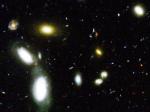 Galaxies in the GOODS
25.06.2003
This tantalizing view of galaxies scattered near and far is part of the Hubble Space Telescope's contribution to the GOODS - the Great Observatories Origins Deep Survey project. The GOODS' goal is to study...
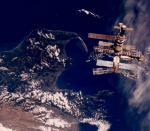 Mir Dreams
18.02.2006
This dream-like image of Mir was recorded by astronauts as the space shuttle orbiter Atlantis approached the Russian space station prior to docking during the STS-76 mission in 1996. Sporting spindly appendages and solar...
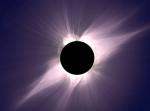 Solar Surfin
16.07.1999
The sun's corona is a tenuous outer atmosphere composed of streams of energetic charged particles, but it is only easily seen from Earth during a total solar eclipse. For example, this 1991 image of totality from atop Mauna Kea, Hawaii forms a fleeting snapshot of the mysterious corona's beautiful, intricate structures and streams.
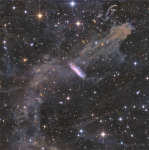 A Galaxy Beyond Stars, Gas, Dust
19.10.2022
Do we dare believe our eyes? When we look at images of space, we often wonder whether they are "real", and just as often the best answer varies. In this case, the scene appears...
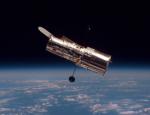 Hubble Floats Free
6.03.1997
Why put observatories in space? Most telescopes are on the ground. On the ground, you can deploy a heavier telescope and upgrade it more easily. The trouble is that Earth-bound telescopes must look through the Earth's atmosphere.
|
January February March April May June July August September October |
|||||||||||||||||||||||||||||||||||||||||||||||||