
|
You entered: Solar System
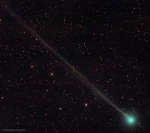 Comet 45P Returns
2.01.2017
An old comet has returned to the inner Solar System. Not only is Comet 45P/HondaMrkosPajduАkovА physically ancient, it was first discovered 13 orbits ago in 1948. Comet 45P spends most of its time out near the orbit of Jupiter and last neared the Sun in 2011.
 Comet Hale-Bopp Outbound
10.09.1997
Hale-Bopp, the Comet of the Century, is leaving the inner Solar System. Outbound at about 12 miles per second it is presently nearing the main asteroid belt between Mars and Jupiter. This false-color image represents a recent view from low Earth orbit showing the comet surrounded by its shrinking coma against a background of stars.
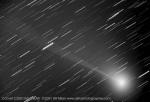 C 2001 A2 (LINEAR): Comet
5.07.2001
Comet C/2001 A2 (LINEAR) has crossed the celestial equator and is heading north. Outward bound, this primordial piece of the solar system is still just visible to the unaided eye and can now be sighted by northern hemisphere skygazers as it moves through the constellation Pisces.
 Water Found in Space Rock
7.09.1999
What would you do if it rained blue water from space? On 1998 March 22, no umbrella was needed, as the blue water came attached to a stony meteorite that landed in Monahans, Texas. The meteorite fall was seen by several boys, and was being carefully scrutinized by NASA scientists within 72 hours.
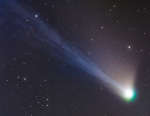 Tails of Comet Lemmon
6.05.2013
What caused the interestingly intricate tails that Comet Lemmon displayed earlier this year? First of all, just about every comet that nears the Sun displays two tails: a dust tail and an ion tail.
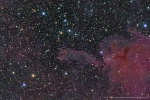 Cometary Globule CG4
5.03.2015
The faint and somehow menacing cometary globule CG4 reaches through the center of this deep southern skyscape. About 1,300 light-years from Earth toward the constellation Puppis, its head is about 1.5 light-years in diameter and its tail about 8 light-years long.
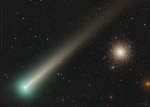 Comet Leonard Before Star Cluster M3
12.12.2021
Comet Leonard is now visible to the unaided eye -- but just barely. Passing nearest to the Earth today, the comet is best seen this week soon after sunset, toward the west, low on the horizon.
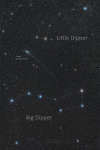 APOD: 2023 February 7 Б A Comet and Two Dippers
7.02.2023
Can you still see the comet? Yes. Even as C/2022 E3 (ZTF) fades, there is still time to see it if you know where and when to look. Geometrically, Comet ZTF has passed its closest to both the Sun and the Earth and is now headed back to the outer Solar System.
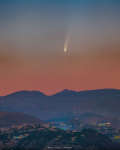 Comet NEOWISE over Lebanon
7.07.2020
A comet has suddenly become visible to the unaided eye. Comet C/2020 F3 (NEOWISE) was discovered in late March and brightened as it reached its closest approach to the Sun, inside the orbit of Mercury, late last week.
 The Last Titan
27.10.2005
On October 19th, a rocket blasted off from Vandengberg Air Force Base - the last Titan rocket. Carrying a payload for the US National Reconnaissance Office, the successful Titan IV B launch brings to a close the Titan program whose first launch was in 1959.
|
January February March April May June July August |
||||||||||||||||||||||||||||||||||||||||||||||||||||||||