
|
You entered: emission nebula
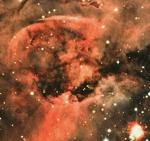 In the Center of the Keyhole Nebula
21.07.1997
Stars, like people, do not always go gentle into that good night. The above Keyhole Nebula results from dying star Eta Carinae's violently casting off dust and gas during its final centuries. Eta Carinae is many times more massive than our own Sun, and should eventually undergo a tremendous supernova explosion.
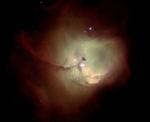 N81: Star Cradle in the SMC
5.10.2000
This dramatic Hubble Space Telescope image captures the birth of a cluster of massive stars. The newborn stars are seen just as they emerge from their natal nebula. Only 12 light-years across, the nebula...
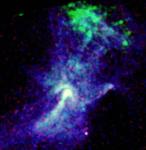 X Rays And The Circinus Pulsar
13.09.2001
A bizarre stellar corpse 19,000 light-years from Earth, pulsar PSR B1509-58 beckons from the small southern constellation of Circinus. Like its cousin at the heart of the Crab nebula, the Circinus pulsar is a rapidly spinning, magnetized neutron star.
 Simeis 147: Supernova Remnant
21.11.2019
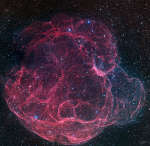
It's easy to get lost following the intricate looping filaments in this detailed image of supernova remnant Simeis 147. Also cataloged as Sharpless 2-240 it goes by the popular nickname, the Spaghetti Nebula.
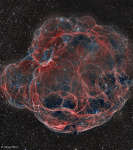 Simeis 147: Supernova Remnant
10.12.2020
It's easy to get lost following the intricate looping filaments in this detailed image of supernova remnant Simeis 147. Also cataloged as Sharpless 2-240 it goes by the popular nickname, the Spaghetti Nebula.
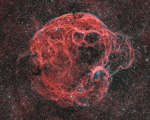 Supernova Remnant Simeis 147
13.01.2022
It's easy to get lost following the intricate, looping, twisting filaments in this detailed image of supernova remnant Simeis 147. Also cataloged as Sharpless 2-240 it goes by the popular nickname, the Spaghetti Nebula.
 Along the Taurus Molecular Cloud
23.11.2023
The cosmic brush of star formation composed this interstellar canvas of emission, dust, and dark nebulae. A 5 degree wide telescopic mosaic, it frames a region found north of bright star Aldebaran on the sky, at an inner wall of the local bubble along the Taurus molecular cloud.
 Simeis 147: Supernova Remnant
18.05.2017
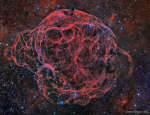
It's easy to get lost following intricate filaments in this detailed image of faint supernova remnant Simeis 147. Also cataloged as Sharpless 2-240 it goes by the popular nickname, the Spaghetti Nebula. Seen toward the boundary of the constellations Taurus and Auriga, it covers nearly 3 degrees or 6 full moons on the sky.
 The Tarantula Nebula
16.11.2017
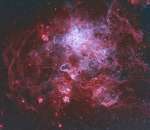
The Tarantula Nebula is more than a thousand light-years in diameter, a giant star forming region within nearby satellite galaxy the Large Magellanic Cloud, about 180 thousand light-years away. The largest, most violent star...
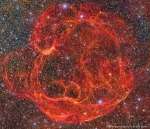 Simeis 147: Supernova Remnant
25.04.2016
It's easy to get lost following the intricate strands of the Spaghetti Nebula. A supernova remnant cataloged as Simeis 147 and Sh2-240, the glowing gas filaments cover nearly 3 degrees -- 6 full moons -- on the sky. That's about 150 light-years at the stellar debris cloud's estimated distance of 3,000 light-years.
|
January February March April May June July August September October |
|||||||||||||||||||||||||||||||||||||||||||||||||