
|
You entered: galaxy center
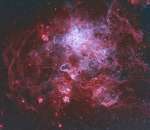 The Tarantula Nebula
16.11.2017
The Tarantula Nebula is more than a thousand light-years in diameter, a giant star forming region within nearby satellite galaxy the Large Magellanic Cloud, about 180 thousand light-years away. The largest, most violent star...
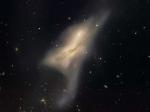 The Colliding Galaxies of NGC 520
12.09.2005
Is this one galaxy or two? The jumble of stars, gas, and dust that is NGC 520 is now thought to incorporate the remains of two separate galaxies. A combination of observations and simulations indicate the NGC 520 is actually the collision of two disk galaxies.
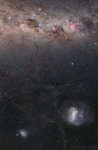 Galaxies and the South Celestial Pole
1.01.2021
The South Celestial Pole is easy to spot in star trail images of the southern sky. The extension of Earth's axis of rotation to the south, it's at the center of all the southern star trail arcs.
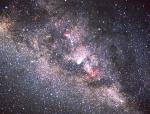 Comet Halley and the Milky Way
3.10.1997
Comet Halley was photographed superposed in front of the disk of our Milky Way Galaxy in 1986 by the Kuiper Airborne Observatory. Comet Halley is the bright white streak near this photograph's center. Comet Halley is the most famous comet in history, and returns to the inner Solar System every 76 years.
 APOD: 2024 December 11 Б The Shells and Jets of Galaxy Centaurus A
11.12.2024
What's the closest active galaxy to planet Earth? That would be Centaurus A, cataloged as NGC 5128, which is only 12 million light-years distant. Forged in a collision of two otherwise normal galaxies...
 Virgo Cluster Galaxies
17.04.2025
Galaxies of the Virgo Cluster are scattered across this nearly 4 degree wide telescopic field of view. About 50 million light-years distant, the Virgo Cluster is the closest large galaxy cluster to our own local galaxy group.
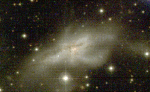 NGC 6240: When Galaxies Collide
28.12.1995
Sometimes even galaxies can suffer a fatal attraction. Here gravity causes two galaxies to collide in a spectacular display of energetic gas, dust, and light. When galaxies collide it is rare that any stars in the galaxies themselves collide, or that any change will be seen in a human lifetime.
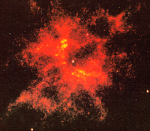 NGC 2440 Nucleus: The Hottest Star?
30.11.1995
In the center of the above photograph lies a star with one of the hottest surface temperatures yet confirmed. This bright white dwarf star's surface has been measured at greater than 200,000 degrees Celsius - more than 30 times hotter than that of our own Sun.
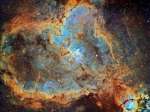 IC 1805: The Heart Nebula
4.03.2013
Sprawling across almost 200 light-years, emission nebula IC 1805 is a mix of glowing interstellar gas and dark dust clouds. Derived from its Valentine's-Day-approved shape, its nickname is the Heart Nebula. About 7,500 light-years away in the Perseus spiral arm of our galaxy, stars were born in IC 1805.
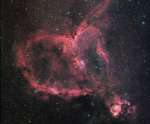 IC 1805: The Heart Nebula
14.02.2009
Sprawling across almost 200 light-years, emission nebula IC 1805 is a mix of glowing interstellar gas and dark dust clouds. Derived from its Valentine's-Day-approved shape, its nickname is the Heart Nebula. About 7,500 light-years away in the Perseus spiral arm of our galaxy, stars were born in IC 1805.
|
January February March April May June July August |
||||||||||||||||||||||||||||||||||||||||||||||||||||||||