
|
You entered: spiral galaxy
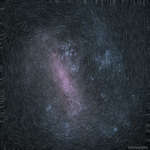 Rotation of the Large Magellanic Cloud
16.05.2018
This image is not blurry. It shows in clear detail that the largest satellite galaxy to our Milky Way, the Large Cloud of Magellan (LMC), rotates. First determined with Hubble, the rotation of the LMC is presented here with fine data from the Sun-orbiting Gaia satellite.
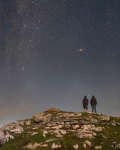 The Galaxy Between Two Friends
6.11.2021
On an August night two friends enjoyed this view after a day's hike on the Plateau d'Emparis in the French Alps. At 2400 meters altitude the sky was clear. Light from a setting moon illuminates the foreground captured in the simple vertical panorama of images.
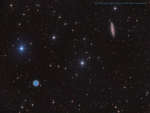 The Owl and the Galaxy
2.04.2015
The Owl and the Galaxy sail these skies With blue and yellow star. They go together beneath the Big Dipper, If you wonder where they are. The Galaxy's light shines through the night, Ten millions of light-years away. But never fear the Owl is near, Inside the Milky Way.
 A Little Drop of Galaxy
27.03.2020
A drop of water seems to hold an entire galaxy in this creative macro-astrophotograph. In the imaginative work of cosmic nature photography a close-up lens was used to image a previously made picture of a galaxy, viewed through a water drop suspended from a stem.
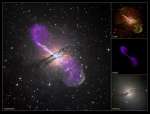 Active Galaxy Centaurus A
10.01.2008
A mere 11 million light-years away, Centaurus A is a giant elliptical galaxy - the closest active galaxy to Earth. This remarkable composite view of the galaxy combines image data from the x-ray ( Chandra), optical(ESO), and radio(VLA) regimes.
 The Hydrogen Clouds of M33
3.10.2019
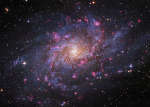
Gorgeous spiral galaxy M33 seems to have more than its fair share of glowing hydrogen gas. A prominent member of the local group of galaxies, M33 is also known as the Triangulum Galaxy and lies a mere 3 million light-years away.
 APOD: 2024 April 15 Б The Cigar Galaxy from Hubble and Webb
15.04.2024
Something strange happened to this galaxy, but what? Known as the Cigar Galaxy and cataloged as M82, red glowing gas and dust are being cast out from the center. Although this starburst galaxy...
 The Century that Defined Galaxy
30.12.1999
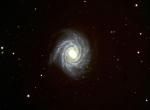
As the twentieth century dawned a debate raged over whether the Milky Way was the entire universe. The 1920s brought observations of spiral-nebulae that housed familiar but faint variable stars, and hence placed these nebulae much farther than anything else ever found. The Milky Way, apparently, is itself a spiral nebula seen from the inside.
 Ringed Nebulae
9.07.2004
Have you heard a lot about ringed planets lately? Well, consider this gorgeous celestial vista centered on the Milky Way's own planetary nebula M57, the famous Ring Nebula. The wide view...
 Ringed Nebulae
23.07.2005
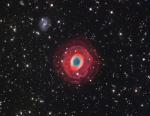
This gorgeous celestial vista is centered on one of the Milky Way's own planetary nebulae, M57, the famous Ring Nebula. The wide view is a composite of three exposures; one to record...
|
January February March April May June July August September October |
|||||||||||||||||||||||||||||||||||||||||||||||||