
|
You entered: star system
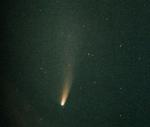 Comet NEAT in Southern Skies
6.03.2003
After last month's dramatic swoop past the Sun, Comet NEAT (C/2002 V1) appeared as a naked-eye comet, emerging from the evening twilight in planet Earth's southern skies. On March 1st, New Zealand...
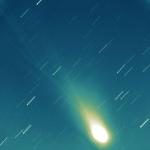 Tails Of Comet LINEAR
27.07.2000
Comet C/1999 S4 LINEAR is only one of many comets discovered with the Lincoln Near Earth Asteroid Research (LINEAR) telescope operating near Soccoro, New Mexico, USA. Traveling steadily southward through Earth's night...
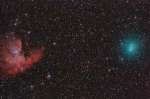 Pacman and Hartley
7.10.2010
Touring the solar system with a 6 year orbital period, small comet Hartley 2 (103/P Hartley) will make its closest approach to planet Earth on October 20 and its closest approach to the Sun on October 28. It may become a naked-eye comet, just visible in clear, dark skies.
 APOD: 2024 March 25 Б Sonified: The Jellyfish Nebula Supernova Remnant
25.03.2024
What does a supernova remnant sound like? Although sound is a compression wave in matter and does not carry into empty space, interpretive sound can help listeners appreciate and understand a visual image of a supernova remnant in a new way. Recently, the Jellyfish Nebula (IC 443) has been sonified quite creatively.
 Planets Ahoy
30.09.2008
Can you spot the Solar System's four rocky planets? In the above image taken on September 20, all of them were visible in a single glance, but some of them may be different than you think. Pictured above, the brightest and highest object in the sky is the planet Venus.
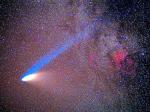 Comet Hale Bopp and the North America Nebula
3.10.2004
Comet Hale-Bopp's 1997 encounter with the inner Solar System allowed many breath-taking pictures. Above, Comet Hale-Bopp was photographed crossing the constellation of Cygnus, sporting spectacular yellow dust and blue ion tails. Visible on the right in red is the North America Nebula, a bright emission nebula observable from a dark location with binoculars.
 Lovejoy in the New Year
3.01.2014
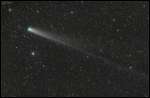
A rival to vanquished Comet ISON in 2013, Comet Lovejoy (C/2013 R1) still sweeps through early morning skies, captured in this starry scene on New Year's day. The frame stretches some 3.5 degrees across a background of faint stars in the constellation Hercules.
 Remembering NEOWISE
31.07.2021
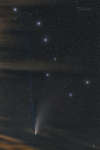
It was just last July. If you could see the stars of the Big Dipper, you could find Comet NEOWISE in your evening sky. After sunset denizens of the north could look for the naked-eye comet below the bowl of that famous celestial kitchen utensil and above the northwestern horizon.
 Comet Meets Ring Nebula: Part I
11.05.2006
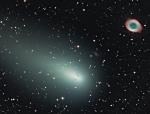
As dawn approached on May 8, astronomer Stefan Seip carefully watched Fragment C of broken comet 73P/Schwassmann-Wachmann 3 approach M57 - the Ring Nebula, and faint spiral galaxy IC 1296. Of course, even though...
 When Z is for Mars
15.04.2023
A composite of images captured about a week apart from mid August 2022 through late March 2023, this series traces the retrograde motion of ruddy-colored Mars. Progressing from lower right to upper left Mars...
|
January February March April May June July August September October |
|||||||||||||||||||||||||||||||||||||||||||||||||