
|
You entered: Milky Way
 APOD: 2024 September 11 Б A Night Sky over the Tatra Mountains
11.09.2024
A natural border between Slovakia and Poland is the Tatra Mountains. A prominent destination for astrophotographers, the Tatras are the highest mountain range in the Carpathians. In the featured image taken...
 The Coma Cluster of Galaxies
13.12.1997
Almost every object in the above photograph is a galaxy. The Coma Cluster of Galaxies pictured is one of the densest clusters known - it contains thousands of galaxies. Each of these galaxies house billions of stars - just as our own Milky Way Galaxy does.
 The Coma Cluster of Galaxies
12.10.2003
Almost every object in the above photograph is a galaxy. The Coma Cluster of Galaxies pictured above is one of the densest clusters known - it contains thousands of galaxies. Each of these galaxies houses billions of stars - just as our own Milky Way Galaxy does.
 A Sky Portal in New Zealand
29.07.2014
To some, it may look like a portal into the distant universe. To others, it may appear as the eye of a giant. Given poetic license, both are correct. Pictured above is a standard fisheye view of the sky -- but with an unusual projection.
 Reflections of the Ghost Nebula
26.10.2020
Do any shapes seem to jump out at you from this interstellar field of stars and dust? The jeweled expanse, filled with faint, starlight-reflecting clouds, drifts through the night in the royal constellation of Cepheus.
 APOD: 2025 June 14 Б Meteors and Satellite Trails over the Limay River
14.06.2025
What are all those streaks in the sky? A galaxy, many satellite trails, and a few meteors. First, far in the distance, the majestic band of our Milky Way Galaxy runs down the left. Mirroring it on the right are several parallel trails of Earth-orbiting Starlink satellites. Many fainter satellite trails also crisscross the image.
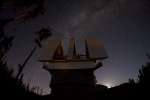 Large Binocular Telescope
16.02.2008
With moonlight on the horizon, a starry sky and the northern Milky Way provide the background for this dramatic view of the World at Night. The imposing structure in the foreground houses the Large Binocular Telescope (LBT), on Mount Graham, Arizona.
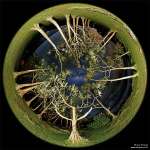 Trees, Sky, Galactic Eye
29.06.2010
Is beauty in the eye of this beholder? Earlier this month, over RИunion Island in the Indian Ocean, a playful photographer with an eye for the sky took eight images and composed the above intriguing picture.
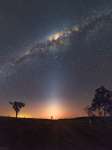 Light at the End of the Road
1.09.2016
The bright light at the end of this country road is actually a remarkably close conjunction of two planets. After sunset on August 27 brilliant Venus and Jupiter almost appear as a single celestial beacon in the night skyscape taken near Lake Wivenhoe, Queensland, Australia.
 Haunting the Cepheus Flare
28.10.2016
Spooky shapes seem to haunt this jeweled expanse, drifting through the night in the royal constellation Cepheus. Of course, the shapes are cosmic dust clouds faintly visible in dimly reflected starlight. Far from your...
|
January February March April May June July August September October |
|||||||||||||||||||||||||||||||||||||||||||||||||