
|
You entered: massive stars
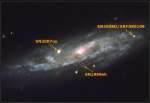 Supernova Factory NGC 2770
18.01.2008
The stellar explosions known as supernovae are among the most powerful events in the universe. Triggered by the collapsing core of a massive star or the nuclear demise of a white dwarf, supernovae occur in average spiral galaxies only about once every century.
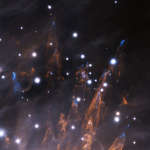 The Orion Bullets
10.01.2013
Cosmic bullets pierce the outskirts of the Orion Nebula some 1500 light-years distant in this sharp infrared close-up. Blasted out by energetic massive star formation the bullets, relatively dense, hot gas clouds about ten times the size of Pluto's orbit, are blue in the false color image.
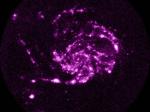 M101: An Ultraviolet View
10.06.2000
This picture of giant spiral galaxy Messier 101 (M101) was taken by the Ultraviolet Imaging Telescope (UIT). UIT flew into orbit as part of the Astro 2 mission on-board the Space Shuttle Endeavour in March 1995.
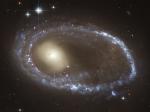 Ring Galaxy AM 0644 741 from Hubble
22.10.2005
How could a galaxy become shaped like a ring? The rim of the blue galaxy pictured on the right is an immense ring-like structure 150,000 light years in diameter composed of newly formed, extremely bright, massive stars.
 Clouds in the LMC
19.01.2018
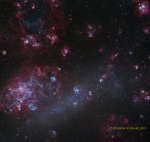
An alluring sight in southern skies, the Large Magellanic Cloud (LMC) is seen in this deep and detailed telescopic mosaic. Recorded with broadband and narrowband filters, the scene spans some 5 degrees or 10 full moons. The narrowband filters are designed to transmit only light emitted by hydrogen, and oxygen atoms.
 The Long Jet of the Lighthouse Nebula
21.02.2014
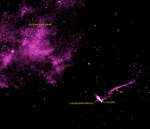
The Lighthouse nebula was formed by the wind of a pulsar, a rapidly rotating, magnetized neutron star, as it speeds through the interstellar medium at over 1,000 kilometers per second. Some...
 A Giant Squid in the Flying Bat
27.10.2016
Very faint but also very large on planet Earth's sky, a giant Squid Nebula cataloged as Ou4, and Sh2-129 also known as the Flying Bat Nebula, are both caught in this cosmic scene toward the royal constellation Cepheus.
 M51: X Rays from the Whirlpool
10.06.2014
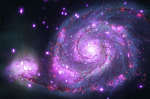
What if we X-rayed an entire spiral galaxy? This was done (again) recently by NASA's Chandra X-ray Observatory for the nearby interacting galaxies known as the Whirlpool (M51). Hundreds of glittering x-ray stars are present in the above Chandra image of the spiral and its neighbor.
 Ring Galaxy AM 0644 741 from Hubble
19.04.2015
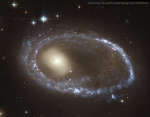
How could a galaxy become shaped like a ring? The rim of the blue galaxy pictured on the right is an immense ring-like structure 150,000 light years in diameter composed of newly formed, extremely bright, massive stars.
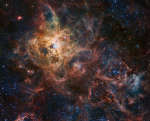 The Tarantula Zone
16.09.2022
The Tarantula Nebula, also known as 30 Doradus, is more than a thousand light-years in diameter, a giant star forming region within nearby satellite galaxy the Large Magellanic Cloud. About 180 thousand light-years away, it's the largest, most violent star forming region known in the whole Local Group of galaxies.
|
January February March April |
|||||||||||||||||||||||||||||||||||||||||||||||||