
|
You entered: Earth's rotation
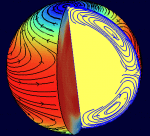 Rivers in the Sun
4.09.1997
The surface of the Sun is shifting. By watching sunspots, it has long been known that our Sun rotates. It was also known that the center of the Sun rotates faster than the poles.
 Sky Full of SARs
17.08.2024
On August 11 a Rocket Lab Electron rocket launched from a rotating planet. With a small satellite on board its mission was dubbed A Sky Full of SARs (Synthetic Aperture Radar satellites), departing for low Earth orbit from Mahia Peninsula on New Zealand's north island.
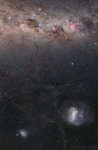 Galaxies and the South Celestial Pole
1.01.2021
The South Celestial Pole is easy to spot in star trail images of the southern sky. The extension of Earth's axis of rotation to the south, it's at the center of all the southern star trail arcs.
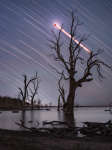 APOD: 2026 March 13 Б Toolondo Totality Trails
13.03.2026
In this composited night skyscape, stacked exposures trace graceful star trails above Lake Toolondo, Victoria, Australia, planet Earth. Captured while the lunar eclipse of March 3 was in progress, the exposures used were made during the hour-long total eclipse phase.
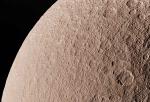 Rhea: Saturns Second Largest Moon
5.12.1999
Rhea is the second largest moon of Saturn, behind Titan, and the largest without an atmosphere. It is composed mostly of water ice, but has a small rocky core. Rhea's rotation and orbit are locked together (just like Earth's Moon) so that one side always faces Saturn.
 Star Trails in Southern Skies
15.07.2000
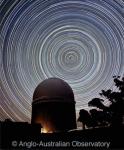
As the Earth spins on its axis, the stars seem to rotate around us. This motion produces the beautiful concentric arcs traced out by the stars in this time exposure of the southern hemisphere night sky. In the foreground is the dome of the Anglo-Australian Telescope in central New South Wales, Australia.
 Rhea: Saturn's Second Largest Moon
8.06.2003
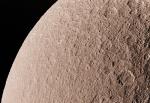
Rhea is the second largest moon of Saturn, behind Titan, and the largest without an atmosphere. It is composed mostly of water ice, but has a small rocky core. Rhea's rotation and orbit are locked together (just like Earth's Moon) so that one side always faces Saturn.
 Rhea: Saturn's Second Largest Moon
14.10.1995
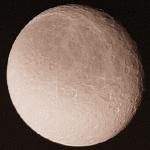
Rhea is the second largest moon of Saturn, behind Titan, and the largest without an atmosphere. It is composed mostly of water ice, but has a small rocky core. Rhea's rotation and orbit are locked together (just like Earth's Moon) so that one side always faces Saturn.
 Mercury from Passing BepiColombo
28.06.2022
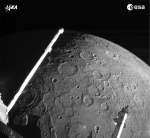
Which part of the Moon is this? No part -- because this is the planet Mercury. Mercury's old surface is heavily cratered like that of Earth's Moon. Mercury, while only slightly larger than Luna, is much denser and more massive than any Solar System moon because it is made mostly of iron.
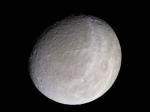 Saturns Moon Rhea from Cassini
15.02.2005
Each moon of Saturn seems to come with its own mystery. Rhea, Saturn's second largest moon behind Titan, shows unusual wisps, visible above as light colored streaks. Higher resolution images of the wisps show them to be made of long braided fractures.
|
January February March April May |
|||||||||||||||||||||||||||||||||||||||||||||||||