
|
You entered: Earth orbit
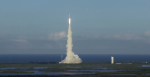 An Atlas V Rocket Launches OSIRIS REx
17.10.2016
Have you ever seen a rocket launched into the Solar System? Last month a large Atlas V rocket blasted off from Launch Complex 41 in Florida carrying the ORISIX-REx spacecraft. This robotic spacecraft will attempt to land on Asteroid Bennu and return some of its soil to Earth.
 APOD: 2024 May 11 Б AR 3664: Giant Sunspot Group
11.05.2024
Right now, one of the largest sunspot groups in recent history is crossing the Sun. Active Region 3664 is not only big -- it's violent, throwing off clouds of particles into the Solar System. Some of these CMEs are already impacting the Earth, and others might follow.
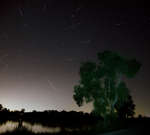 Perseid Meteors Over Ontario
13.08.2013
Where are all of these meteors coming from? In terms of direction on the sky, the pointed answer is the constellation of Perseus. That is why the meteor shower that peaked over the past few days is known as the Perseids -- the meteors all appear to come from a radiant toward Perseus.
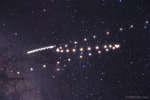 Retrograde Mars and Saturn
15.09.2016
Wandering Mars and Saturn have spent much of this year remarkably close in planet Earth's night sky. In a sequence of exposures spanning mid-December 2015 through the beginning of this week, this composited...
 When Z is for Mars
15.04.2023
A composite of images captured about a week apart from mid August 2022 through late March 2023, this series traces the retrograde motion of ruddy-colored Mars. Progressing from lower right to upper left Mars...
 APOD: 2024 May 13 Б AR 3664 on a Setting Sun
13.05.2024
It was larger than the Earth. It was so big you could actually see it on the Sun's surface without magnification. It contained powerful and tangled magnetic fields as well as numerous dark sunspots.
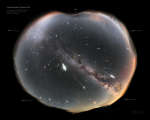 Perseids from Perseus
10.08.2020
Where are all these meteors coming from? In terms of direction on the sky, the pointed answer is the constellation of Perseus. That is why the meteor shower that peaks tomorrow night is known as the Perseids -- the meteors all appear to came from a radiant toward Perseus.
 Mars in the Loop
30.05.2025
This composite of images spaced a weather-permitting 5 to 9 days apart, from 2024 September 19 (top right) through 2025 May 18 (bottom left), faithfully traces ruddy-colored Mars as it makes a clockwise loop through the constellations Gemini and Cancer in planet Earth's night sky.
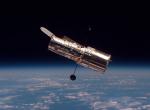 Hubble Floats Free
24.11.2002
Why put observatories in space? Most telescopes are on the ground. On the ground, you can deploy a heavier telescope and fix it more easily. The trouble is that Earth-bound telescopes must look through the Earth's atmosphere.
 Perseid Meteors over Mount Shasta
8.08.2016
Where are all of these meteors coming from? In terms of direction on the sky, the pointed answer is the constellation of Perseus. That is why the meteor shower that peaks later this week is known as the Perseids -- the meteors all appear to came from a radiant toward Perseus.
|
January February March April May June July August September October |
|||||||||||||||||||||||||||||||||||||||||||||||||