
|
You entered: Ganymede
 Jupiter Moon Movie
29.03.2007
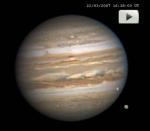
South is toward the top in this frame from a stunning movie featuring Jupiter and moons recorded last Thursday from the Central Coast of New South Wales, Australia. In fact, three jovian moons and two red spots are ultimately seen in the full video as they glide around the solar system's ruling gas giant.
 APOD: 2025 September 1 Б Callisto: Dirty Battered Iceball
1.09.2025
Its surface is the most densely cratered in the Solar System -- but what's inside? Jupiter's moon Callisto is a battered ball of dirty ice that is larger than the planet Mercury.
 Galileo's First Color Image of Io
19.07.1996
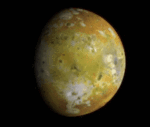
Above is the first color image of Jupiter's volcanic moon Io released by the Galileo Project. (Io sounds like "eye-oh".) The image was made on June 25 when the Galileo spacecraft approached within 1.4 million miles.
 A Face in the Clouds of Jupiter from Juno
8.06.2021
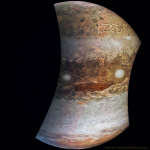
What do you see in the clouds of Jupiter? On the largest scale, circling the planet, Jupiter has alternating light zones and reddish-brown belts. Rising zone gas, mostly hydrogen and helium, usually swirls around regions of high pressure. Conversely, falling belt gas usually whirls around regions of low pressure, like cyclones and hurricanes on Earth.
 When Moons and Shadows Dance
27.02.2003
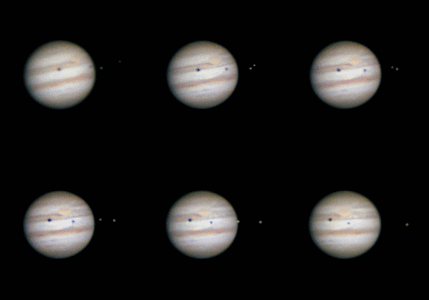
It's no wonder Jupiter is a favorite target for even modest earthbound telescopes. The most massive planet in the solar system with four of the largest moons also boasts the famous Great Red Spot, a giant hurricane-like storm system over three hundred years old.
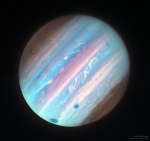 Jupiter in Ultraviolet from Hubble
16.10.2018
Jupiter looks a bit different in ultraviolet light. To better interpret Jupiter's cloud motions and to help NASA's robotic Juno spacecraft understand the planetary context of the small fields that it sees, the Hubble Space Telescope is being directed to regularly image the entire Jovian giant.
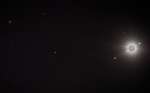 Two Planet Opposition
8.10.2010
In late September, two planets were opposite the Sun in Earth's sky, Jupiter and Uranus. Consequently closest to Earth, at a distance of only 33 light-minutes and 2.65 light-hours respectively, both were good targets for telescopic observers.
|
January February March April May June July August September October |
|||||||||||||||||||||||||||||||||||||||||||||||||