
|
You entered: Great Red Spot
 Stereo Jupiter near Opposition
5.12.2024
Jupiter looks sharp in these two rooftop telescope images. Both were captured last year on November 17 from Singapore, planet Earth, about two weeks after Jupiter's 2023 opposition. Climbing high in midnight skies the giant planet was a mere 33.4 light-minutes from Singapore. That's about 4 astronomical units away.
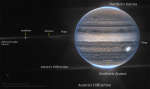 Jupiter from the Webb Space Telescope
30.08.2022
This new view of Jupiter is illuminating. High-resolution infrared images of Jupiter from the new James Webb Space Telescope (Webb) reveal, for example, previously unknown differences between high-floating bright clouds -- including the Great Red Spot -- and low-lying dark clouds.
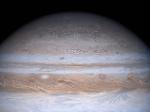 Jupiters Clouds from Cassini
11.09.2005
Gas giant Jupiter is the solar system's largest world with about 320 times the mass of planet Earth. Famous for its Great Red Spot, Jupiter is also known for its regular, equatorial cloud bands, visible in very modest sized telescopes.
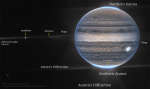 APOD: 2026 January 18 Б Jupiter from the Webb Space Telescope
18.01.2026
This infrared view of Jupiter by Webb is illuminating. High-resolution infrared images of Jupiter from the James Webb Space Telescope (Webb) reveal, for example, differences between high-floating bright clouds -- including the Great Red Spot -- and low-lying dark clouds.
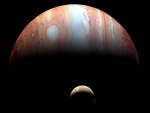 A Jupiter Io Montage from New Horizons
8.01.2008
As the New Horizons spacecraft sweeps through the Solar System, it is taking breathtaking images of the planets. In February of last year, New Horizons passed Jupiter and the ever-active Jovian moon Io. In this montage, Jupiter was captured in three bands of infrared light making the Great Red Spot look white.
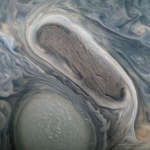 Giant Storms and High Clouds on Jupiter
29.12.2021
What and where are these large ovals? They are rotating storm clouds on Jupiter imaged last month by NASA's Juno spacecraft. In general, higher clouds are lighter in color, and the lightest clouds visible are the relatively small clouds that dot the lower oval.
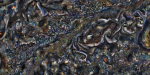 Jupiter Cloud Animation from Juno
21.05.2018
How do Jupiter's clouds move? To help find out, images taken with NASA's Juno spacecraft during its last pass near Jupiter have been analyzed and digitally extrapolated into a time-lapse video.
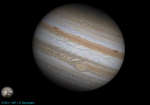 Jupiter Rotates
26.10.2021
Observe the graceful twirl of our Solar System's largest planet. Many interesting features of Jupiter's enigmatic atmosphere, including dark belts and light zones, can be followed in detail. A careful inspection will reveal that different cloud layers rotate at slightly different speeds.
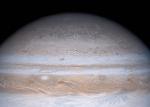 Jupiter s Brain
1.02.2001
Gas giant Jupiter is the solar system's largest world with about 320 times the mass of planet Earth. Famous for its Great Red Spot, Jupiter is also known for its regular, equatorial cloud bands, visible in very modest sized telescopes.
 Jupiter: When Storms Collide
22.10.1998
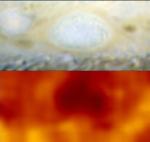
Sometime in February, two of three long-lived Jovian storm systems known as "white ovals" apparently collided and merged -- forming what is now likely the second largest storm in the Solar System, after the famous Great Red Spot.
|
January February March April May June July August September October |
|||||||||||||||||||||||||||||||||||||||||||||||||