
|
You entered: Moon
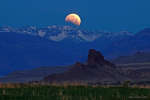 Eclipsed Moon Over Wyoming
6.06.2012
A setting full moon rarely looks like this. Monday morning just before a fully lit Strawberry Moon dropped behind the Absaroka Mountain Range near Cody, Wyoming, USA, the shadow of the Earth got in the way.
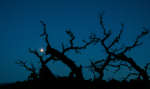 Blood Monster Moon
4.06.2021
On May 26, the Full Flower Moon was caught in this single exposure as it emerged from Earth's shadow and morning twilight began to wash over the western sky. Posing close...
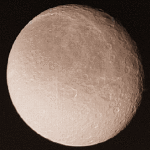 Rhea: Saturn's Second Largest Moon
14.10.1995
Rhea is the second largest moon of Saturn, behind Titan, and the largest without an atmosphere. It is composed mostly of water ice, but has a small rocky core. Rhea's rotation and orbit are locked together (just like Earth's Moon) so that one side always faces Saturn.
 The Iron Moon
1.06.1996
In March and April of 1994 the unmanned Clementine spacecraft demonstrated the technique of prospecting on the Moon from lunar orbit. To accomplish this, Clementine turned an array of cameras sensitive to ultraviolet-visible and near-infrared light toward the lunar surface, producing the first broad-spectrum global imaging of the moon.
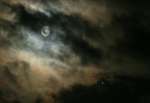 Moons and Jupiter
14.07.2009
Earth's Moon and planet Jupiter made a beautiful pairing in the night sky late last week. This skyscape recorded on July 11 from Brittany in north western France captures the bright conjunction through a cloud bank.
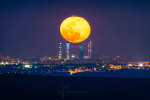 Four Towers and the Equinox Moon
23.03.2019
The first Full Moon of northern spring rises behind four distant towers in this telescopic view. In an image captured from some 40 kilometers west of the city of Madrid, this moonrise also represents a near coincidence of the full lunar phase with lunar perigee and the March equinox.
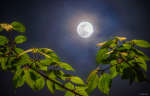 Full Moon of Spring
10.04.2020
From home this Full Moon looked bright. Around our fair planet it rose as the Sun set on April 7/8, the first Full Moon after the vernal equinox and the start of northern hemisphere spring. April's full lunar phase was also near perigee, the closest point in the Moon's elliptical orbit.
 Mars, Antares, Moon, and Saturn
4.10.2014
Mars, Antares, Moon, and Saturn are the brightest celestial beacons in this serene sky. The Sun's golden light is still scattered along the southwestern horizon though, captured after sunset on September 28.
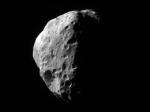 Epimetheus: A Small Moon of Saturn
24.08.2005
How did Epimetheus form? No one is yet sure. To help answer that question, this small moon has recently been imaged again in great detail by the robot spacecraft Cassini now orbiting Saturn. Epimetheus sometimes orbits Saturn in front of Janus, another small satellite, but sometimes behind.
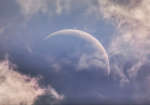 APOD: 2026 June 20 Б Daytime Moon Meets Evening Star
20.06.2026
Venus is now appearing on the celestial stage as Earth's brilliant evening star, performing with the Moon, other wandering planets, and bright stars in western skies. For evening sky gazers on June 17, the celestial beacon rose after sunset close by a young, slender, crescent Moon.
|
January February March April May June July August September October |
|||||||||||||||||||||||||||||||||||||||||||||||||