
|
You entered: Near Earth Objects
 Watch the Sky Rotate
10.01.2001
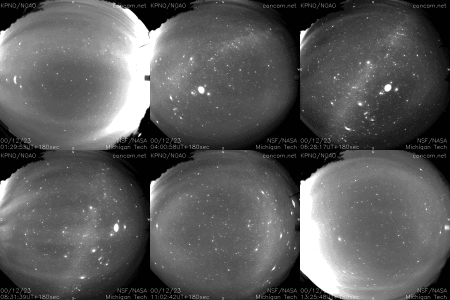
If you could watch the sky for an entire night, what would you see? The above time-lapse sequence from the CONtinuous CAMera (CONCAM) project shows the answer for the skies above Kitt Peak National Observatory on 2000 December 23.
 APOD: 2024 April 29 Б Comet, Planet, Moon
29.04.2024
Three bright objects satisfied seasoned stargazers of the western sky just after sunset earlier this month. The most familiar was the Moon, seen on the upper left in a crescent phase. The rest of the Moon was faintly visible by sunlight first reflected by the Earth.
 Polaris and Comet Lovejoy
2.06.2015
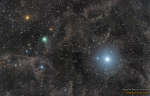
One of these two bright sky objects is moving. On the right is the famous star Polaris. Although only the 45th brightest star in the sky, Polaris is famous for appearing stationary. Once you find it, it will always appear in the same direction -- all night and all day -- for the rest of your life.
 Eight Planets and New Solar System Designations
28.08.2006
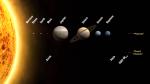
How many planets are in the Solar System? This popular question now has a new formal answer according the International Astronomical Union (IAU): eight. Last week, the IAU voted on a new definition for planet and Pluto did not make the cut.
 Mars and a Colorful Lunar Fog Bow
2.02.2010
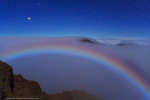
Even from the top of a volcanic crater, this vista was unusual. For one reason, Mars was dazzlingly bright two weeks ago, when this picture was taken, as it was nearing its brightest time of the entire year. Mars, on the far upper left, is the brightest object in the above picture.
 Supermoon Over Paris
7.05.2012
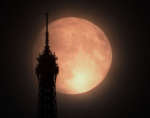
Did you see that full Moon Saturday night? Dubbed a supermoon, the latest fully illuminated moon appeared slightly larger than usual because it occurred unusually near the closest point in its orbit to Earth. Pictured above, the supermoon was captured Saturday night rising behind the top of the Eiffel Tower in Paris, France.
 Red Aurora Over Australia
29.01.2017
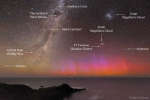
Why would the sky glow red? Aurora. A solar storm in 2012, emanating mostly from active sunspot region 1402, showered particles on the Earth that excited oxygen atoms high in the Earth's atmosphere. As the excited element's electrons fell back to their ground state, they emitted a red glow.
 Red Aurora Over Australia
1.02.2012
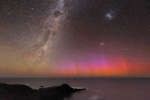
Why would the sky glow red? Aurora. Last week's solar storms, emanating mostly from active sunspot region 1402, showered particles on the Earth that excited oxygen atoms high in the Earth's atmosphere. As the excited element's electrons fell back to their ground state, they emitted a red glow.
 APOD: 2023 August 21 Б Introducing Comet Nishimura
21.08.2023
Will Comet Nishimura become visible to the unaided eye? Given the unpredictability of comets, no one can say for sure, but it currently seems like a good bet. The comet was discovered only ten days ago by Hideo Nishimura during 30-second exposures with a standard digital camera.
 Moon and Venus Appulse over a Tree
6.02.2019
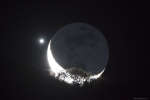
What's that bright spot near the Moon? Venus. About a week ago, Earth's Moon appeared unusually close to the distant planet Venus, an angular coincidence known as an appulse. Similar to a conjunction, which is a coordinate term, an appulse refers more generally to when two celestial objects appear close together.
|
January February March April May June July August September |
|||||||||||||||||||||||||||||||||||||||||||||||||