
|
You entered: X-ray
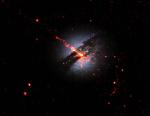 X Ray Jet From Centaurus A
28.10.1999
Spanning over 25,000 light-years, comparable to the distance from the Sun to the center of our own Milky Way galaxy, a cosmic jet seen in X-rays blasts from the center of Centaurus A. Only 10 million light-years away, Centaurus A is a giant elliptical galaxy - the closest active galaxy to Earth.
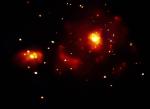 M51: X Rays from the Whirlpool
11.07.2002
Fresh from yesterday's episode, a popular pair of interacting galaxies known as the Whirlpool debut here beyond the realm of visible light -- imaged at high energies by the orbiting Chandra X-ray Observatory. Still turning in a remarkable performance, over 80 glitering x-ray stars are present in the Chandra image data from the region.
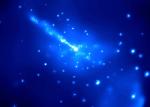 Centaurus A: X-Rays from an Active Galaxy
5.07.2003
Its core hidden from optical view by a thick lane of dust, the giant elliptical galaxy Centaurus A was among the first objects observed by the orbiting Chandra X-ray Observatory. Astronomers were not disappointed, as Centaurus A's appearance in x-rays makes its classification as an active galaxy easy to appreciate.
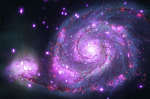 M51: X Rays from the Whirlpool
10.06.2014
What if we X-rayed an entire spiral galaxy? This was done (again) recently by NASA's Chandra X-ray Observatory for the nearby interacting galaxies known as the Whirlpool (M51). Hundreds of glittering x-ray stars are present in the above Chandra image of the spiral and its neighbor.
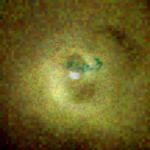 X-Rays From The Perseus Cluster Core
15.06.2000
The Perseus Cluster of thousands of galaxies, 320 million light-years distant, is one of the most massive objects in the Universe. At its core lies the giant cannibal galaxy Perseus A (NGC 1275), accreting matter as gas and galaxies fall into it.
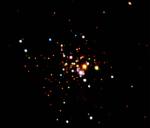 X Ray Stars of 47 Tuc
21.07.2005
Visible light images show the central region of globular cluster 47 Tucanae is closely packed, with stars less than a tenth of a light-year apart. This Chandra false-color x-ray view of central...
 APOD: 2024 January 7 Б The Cats Eye Nebula in Optical and X-ray
7.01.2024
To some it looks like a cat's eye. To others, perhaps like a giant cosmic conch shell. It is actually one of the brightest and most highly detailed planetary nebula known, composed of gas expelled in the brief yet glorious phase near the end of life of a Sun-like star.
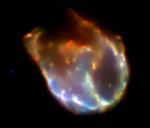 N132D and the Color of X Rays
23.05.2002
Supernova remnant N132D shows off complex structures in this sharp, color x-ray image. Still, overall this cosmic debris from a massive star's explosive death has a strikingly simple horseshoe shape. While N132D lies 180,000 light-years distant in the Large Magellanic Cloud, the expanding remnant appears here about 80 light-years across.
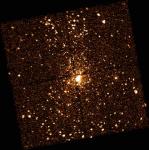 X-Ray Stars Of Orion
4.02.2000
The stars of Orion shine brightly in northern winter skies where the constellation harbors the closest large stellar nursery, the Great Nebula of Orion, a mere 1500 light-years away. In fact, the apparently bright...
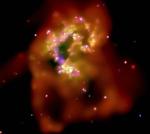 X Rays From Antennae Galaxies
3.02.2004
A bevy of black holes and neutron stars shine as bright, point-like sources against bubbles of million degree gas in this false-color x-ray image from the orbiting Chandra Observatory. The striking picture spans about...
|
January February March April May June July August September October |
|||||||||||||||||||||||||||||||||||||||||||||||||