
|
You entered: annular solar eclipse
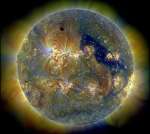 Venus and the Triply Ultraviolet Sun
20.08.2013
An unusual type of solar eclipse occurred last year. Usually it is the Earth's Moon that eclipses the Sun. Last June, most unusually, the planet Venus took a turn. Like a solar eclipse by the Moon, the phase of Venus became a continually thinner crescent as Venus became increasingly better aligned with the Sun.
 Mercurys Transit: An Unusual Spot on the Sun
24.08.2014
What's that dot on the Sun? If you look closely, it is almost perfectly round. The dot is the result of an unusual type of solar eclipse that occurred in 2006. Usually it is the Earth's Moon that eclipses the Sun. This time, the planet Mercury took a turn.
 Mercurys Transit: An Unusual Spot on the Sun
14.11.2006
What's that dot on the Sun? If you look closely, it is almost perfectly round. The dot is the result of an unusual type of solar eclipse that occurred last week. Usually it is the Earth's Moon that eclipses the Sun.
 Mercurys Transit: An Unusual Spot on the Sun
8.05.2016
What's that dot on the Sun? If you look closely, it is almost perfectly round. The dot is the result of an unusual type of solar eclipse that occurred in 2006. Usually it is the Earth's Moon that eclipses the Sun. This time, the planet Mercury took a turn.
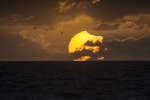 A Partially Eclipsed Setting Sun
30.04.2014
If you look closely, you will see something quite unusual about this setting Sun. There are birds flying to the Sun's left, but that's not so unusual. A dark sea covers the Sun's bottom, and dark clouds cover parts of the middle, but they are also not very unusual.
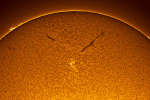 A Sunspot in the New Solar Cycle
6.02.2008
A new cycle has begun on our Sun. Over the past year, the Sun's magnetic field has reset and now a new 11 year period is beginning. Pictured above in a specific color of light emitted by hydrogen is sunspot 10982, one of the first sunspots of the new solar cycle.
 Ring of Fire over Monument Valley
5.10.2023
Tracking along a narrow path, the shadow of a new moon will race across North, Central, and South America, on October 14. When viewed from the shadow path the apparent size of the lunar disk will not quite completely cover the Sun though.
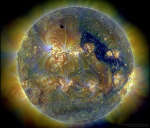 Venus and the Triply Ultraviolet Sun
6.03.2022
This was a very unusual type of solar eclipse. Typically, it is the Earth's Moon that eclipses the Sun. In 2012, though, the planet Venus took a turn. Like a solar eclipse by the Moon, the phase of Venus became a continually thinner crescent as Venus became increasingly better aligned with the Sun.
 APOD: 2025 March 16 Б Venus and the Triply Ultraviolet Sun
16.03.2025
This was a very unusual type of solar eclipse. Typically, it is the Earth's Moon that eclipses the Sun. In 2012, though, the planet Venus took a turn. Like a solar eclipse by the Moon, the phase of Venus became a continually thinner crescent as Venus became increasingly better aligned with the Sun.
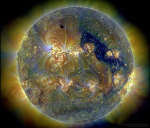 Venus and the Triply Ultraviolet Sun
4.02.2018
An unusual type of solar eclipse occurred in 2012. Usually it is the Earth's Moon that eclipses the Sun. That year, most unusually, the planet Venus took a turn. Like a solar eclipse by the Moon, the phase of Venus became a continually thinner crescent as Venus became increasingly better aligned with the Sun.
|
January February March April May June July August September October |
|||||||||||||||||||||||||||||||||||||||||||||||||