
|
You entered: comet
 Earth, Clouds, Sky, Comet
3.04.1997
Does a comet's dust tail always orbit behind it? Since comets rotate, they shed gas and dust in all directions equally. Small ice and dust particles expelled by the comet, however, are literally pushed around by sunlight. The smaller the particle, the greater the effect.
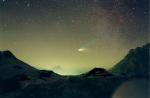 Comet Hale-Bopp Over Val Parola Pass
27.05.2001
Comet Hale-Bopp became much brighter than any surrounding stars. It was seen even over bright city lights. Out away from city lights, however, it put on quite a spectacular show. Here Comet Hale-Bopp was photographed above Val Parola Pass in the Dolomite mountains surrounding Cortina d'Ampezzo, Italy.
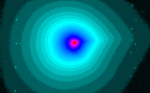 Near Comet Hyakutake's Nucleus
21.03.1996
This March 19th false-color picture of Comet Hyakutake from one of the most sophisticated ground based telescopes captures the area surrounding the comet's nucleus. A comet's nucleus - not directly visible here - is a solid dirty iceball probably no more than 10 kilometers across.
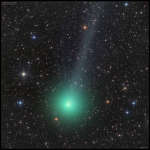 This Comet Lovejoy
24.12.2014
Comet Lovejoy, C/2014 Q2, is framed like a cosmic Christmas tree with starry decorations in this colorful telescopic portrait, snapped on December 16th. Its lovely coma is tinted green by diatomic C2 gas fluorescing in sunlight.
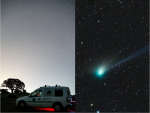 Naked Eye Comet ZTF
21.01.2023
Comet C/2022E3 (ZTF) is no longer too dim to require a telescope for viewing. By January 19, it could just be seen with the naked eye in this rural sky with little light pollution from a location about 20 kilometers from Salamanca, Spain.
 Bright Comet SOHO
21.05.1998
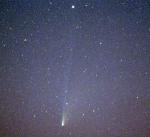
Discovered this month with an orbiting solar observatory, bright Comet SOHO has now emerged from the Sun's glare. This telephoto picture of the new naked-eye comet was taken by astrophotographer Michael Horn after sunset in the western twilight above Lake Samsonvale, Brisbane, Australia on May 18. The comet is seen in the constellation Orion.
 Hale-Bopp Brightest Comet This Decade
13.03.1997
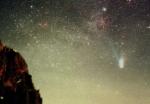
The Great Comet of 1997 is now brighter than the Great Comet of 1996 ever was. In fact, it is brighter than almost every star in the sky. Yet Comet Hale-Bopp is still about two weeks away from maximum light.
 Comet Lovejoy before a Globular Star Cluster
30.12.2014
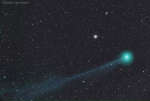
Comet Lovejoy has become visible to the unaided eye. To see the comet, just go outside an hour or so after sunset and look for a fuzzy patch to the right of Orion's belt. Binoculars and a star chart may help.
 Five Bright Comets from SOHO
10.10.2024
Five bright comets are compared in these panels, recorded by a coronograph on board the long-lived, sun-staring SOHO spacecraft. Arranged chronologically all are recognizable by their tails streaming away from...
 Tail Wags of Comet Ikeya Zhang
15.05.2002
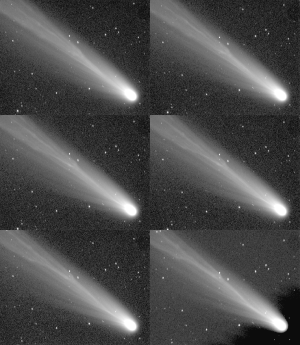
As Comet Ikeya-Zhang approached the Sun two months ago, it developed a complex blue ion tail. The tail was composed of ions that boiled off the nucleus and were pushed away from the Sun by the out-flowing fast-moving particles of the solar wind.
|
January February March April May June July August September October |
|||||||||||||||||||||||||||||||||||||||||||||||||