
|
You entered: comet tail
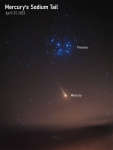 Mercurys Sodium Tail
2.05.2022
That's no comet. Below the Pleiades star cluster is actually a planet: Mercury. Long exposures of our Solar System's innermost planet may reveal something unexpected: a tail. Mercury's thin atmosphere contains small amounts of sodium that glow when excited by light from the Sun.
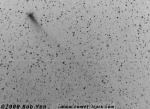 Comet LINEAR Extends
10.07.2000
Comet LINEAR's tail appears to be extending. Many sky watchers are closely following Comet C/1999 S4 LINEAR and wondering if it will develop an impressive tail or become visible to the naked eye later this month.
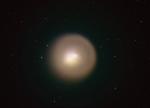 Golden Comet Holmes
2.11.2007
Surprising Comet Holmes remains easily visible as a round, fuzzy cloud in the northern constellation Perseus. Skywatchers with telescopes, binoculars, or those that just decide to look up can enjoy the solar system's latest prodigy as it glides about 150 million kilometers from Earth, beyond the orbit of Mars.
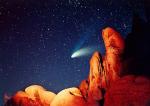 A Farewell to Tails
14.12.1997
As 1997 fades, so does the Great Comet of 1997: Comet Hale-Bopp. Discovered even before the Great Comet of 1996, Comet Hale-Bopp became the brightest comet since 1976. Many will remember Comet Hale-Bopp as a comet with a coma so bright it could be seen by eye even when near the Moon.
 APOD: 2024 October 21 Б Comet Tsuchinshan ATLAS over California
20.10.2024
The tails of Comet Tsuchinshan-ATLAS were a sight to behold. Pictured, C/2023 A3 (TsuchinshanБATLAS) was captured near peak impressiveness last week over the Eastern Sierra Mountains in California, USA. The comet not only showed a bright tail, but a distinct anti-tail pointing in nearly the opposite direction.
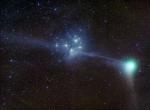 Machholz Meets the Pleiades
10.01.2005
Sweeping northward in planet Earth's sky, comet Machholz extended its long ion tail with the Pleiades star cluster in the background on January 7th. This stunning view, recorded with a telephoto lens in skies over Oberjoch, Bavaria, Germany, emphasizes faint, complex tail structures and the scene's lovely blue and green colors.
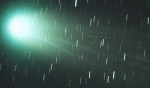 Comet Hyakutake's Closest Approach
23.03.1996
The above true color image of Comet Hyakutake was taken the night of March 21/22. Tonight, Comet Hyakutake will make its nearest approach to Earth, closing to a mere 10 million miles as it passes over the planet's Northern Hemisphere.
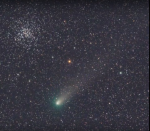 Salt Pepper and Ice
17.09.2018
There's a "camera" comet now moving across the sky. Just a bit too dim to see with the unaided eye, Comet 21P / Giacobini-Zinner has developed a long tail that makes it a good sight for binoculars and sensitive cameras.
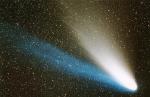 Springtime Comet Fever
19.03.1997
Today marks the Vernal Equinox, the first day of Spring for planet Earth's northern hemisphere. Despite recent attempts by other spectacular and dramatic celestial events to take center stage, Comet Hale-Bopp remains the most popular object in the sky (according to APOD access logs!) and is likely to make this spring memorable for many.
 A Tale of Comet Holmes
9.11.2007
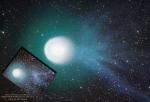
A beautiful blue ion tail has become visible in deep telescopic images of Comet Holmes. Pointing generally away from the Sun and also planet Earth, the comet's ion tail is seriously foreshortened by our extreme viewing angle.
|
January February March April |
|||||||||||||||||||||||||||||||||||||||||||||||||