
|
You entered: distance scale
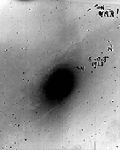 Andromeda Nebula: Var!
6.04.1996
In the 1920s, using photographic plates made with the Mt. Wilson Observatory's 100 inch telescope, Edwin Hubble determined the distance to the Andromeda Nebula - decisively demonstrating the existence of other galaxies far beyond the Milky Way.
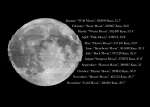 The Full Moon of 2021
1.01.2022
Every Full Moon of 2021 shines in this year-spanning astrophoto project, a composite portrait of the familiar lunar nearside at each brightest lunar phase. Arranged by moonth, the year progresses in stripes beginning at the top.
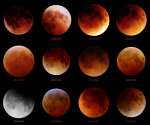 Twelve Lunar Eclipses
29.02.2008
Welcome to the extra day in the Gregorian Calendar's leap year 2008! To celebrate, consider this grid of lunar eclipse pictures - starting in leap year 1996 and ending with February's eclipse - with the date in numerical year/month/day format beneath each image.
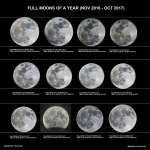 A Year of Full Moons
5.11.2017
Do all full moons look the same? No. To see the slight differences, consider this grid of twelve full moons. From upper left to lower right, the images represent every lunation from 2016 November through 2017 October, as imaged from Pakistan.
 Possible Planets And Infrared Dust
20.01.1999
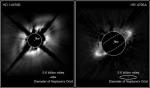
These near-infrared Hubble images of dust surrounding young stars offer the latest tantalizing evidence for planets beyond our Solar System. At left, the dark gap seen in the dust disk is reminiscent of a similar large gap in Saturn's rings believed to be sculpted by orbiting moons.
 Near Comet Hyakutake's Nucleus
21.03.1996
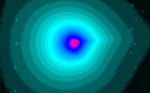
This March 19th false-color picture of Comet Hyakutake from one of the most sophisticated ground based telescopes captures the area surrounding the comet's nucleus. A comet's nucleus - not directly visible here - is a solid dirty iceball probably no more than 10 kilometers across.
 2dF Sees Waves of Galaxies
4.09.2001
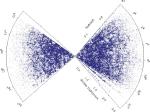
How are galaxies distributed in the universe? This question is of more than aesthetic interest because the answer likely holds clues to composition of the universe itself. The above map shows the distribution...
 Twenty Full Moons
3.01.2007
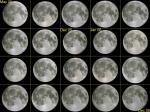
In celebration of tonight's Full Moon, the first of 2007, consider this grid of twenty Full Moons. From upper left to lower right, the images represent every lunation from May 2005 through December 2006.
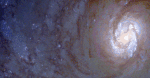 M100 and the Expanding Universe
9.01.1996
The distance to the swirling grand design spiral M100 is causing quite a stir among astronomers. Many believe that the Hubble Space Telescope's recent distance measurement to this galaxy accurately calibrates the expansion rate of the universe. Others believe this distance measurement is misleading.
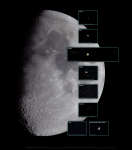 One Night One Telescope One Camera
28.07.2018
Taken on the same night, from the same place, with the same telescope and camera, these postcards from our Solar System are shown at the same scale to provide an interesting comparison of apparent sizes. Spanning about half a degree in planet Earth's sky, the Moon is a stitched mosaic of six images.
|
January February March April May June July August September October |
|||||||||||||||||||||||||||||||||||||||||||||||||