
|
You entered: proton
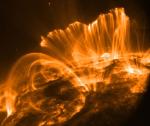 Coronal Rain, Solar Storm
14.11.2000
In this picture, the Sun's surface is quite dark. A frame from a movie recorded on November 9th by the orbiting TRACE telescope, it shows coronal loops lofted over a solar active region.
 APOD: 2025 September 19 Б The NGC 6914 Complex
18.09.2025
A study in contrasts, this colorful cosmic skyscape features stars, dust, and glowing gas in the vicinity of NGC 6914. The interstellar complex of nebulae lies some 6,000 light-years away, toward the high-flying northern constellation Cygnus and the plane of our Milky Way Galaxy.
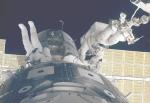 Assembling The International Space Station
9.12.1998
Batteries and solar panels were included with this version of the International Space Station (ISS) but some assembly is still required. On Saturday, December 5th, the STS-88 crew of the Space Shuttle Endeavor achieved the in orbit docking of the Zarya and Unity (foreground) ISS modules.
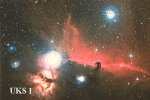 Orion's Horsehead Nebula
24.09.1995
The black indentation to the red emission nebula seen just to the right of center of the above photograph is one of the most famous features in any nebulae on the sky. Because of its shape, it is known as the Horsehead Nebula.
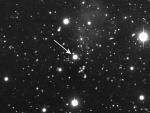 QSO H1821 643 Indicates a Universe Filled with Hydrogen
16.05.2000
A quasar slightly depleted of a specific color of light may indicate that our universe is filled with massive amounts of ionized hydrogen. Light from QSO H1821+643, pictured above, comes to us from about a quarter of the way across the visible universe.
 APOD: 2023 August 15 Б A Triply Glowing Night Sky over Iceland
14.08.2023
The Sun is not the quiet place it seems. It expels an unsteady stream of energetic electrons and protons known as the solar wind. These charged particles deform the Earth's magnetosphere, change paths...
 APOD: 2025 July 30 Б Coronal Loops on the Sun
29.07.2025
Our Sun frequently erupts in loops. Hot solar plasma jumps off the Sun's surface into prominences, with the most common type of prominence being a simple loop. The loop shape originates from the Sun's magnetic field, which is traced by spiraling electrons and protons.
 The Horsehead Nebula
15.12.2015
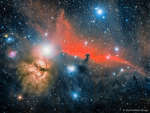
The Horsehead Nebula is one of the most famous nebulae on the sky. It is visible as the dark indentation to the red emission nebula in the center of the above photograph. The horse-head feature is dark because it is really an opaque dust cloud that lies in front of the bright red emission nebula.
 HH111's 12 Light-Year Star Jet
20.03.2000
The complex interactions of three stars in the Orion B molecular cloud complex have resulted in the ejection of particles along a 12 light-year long jet. One of the stars in the HH111 system has apparently also been ejected leaving two stars tightly bound in a binary orbit.
 IC 405: The Flaming Star Nebula
6.01.2020
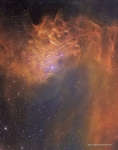
Rippling dust and gas lanes give the Flaming Star Nebula its name. The orange and purple colors of the nebula are present in different regions and are created by different processes. The bright star...
|
January February March April May June July August |
||||||||||||||||||||||||||||||||||||||||||||||||||||||||