
|
You entered: reflection nebula
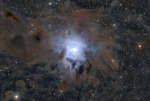 NGC 7023: The Iris Nebula
16.01.2026
These cosmic clouds have blossomed 1,300 light-years away in the fertile starfields of the constellation Cepheus. Called the Iris Nebula, NGC 7023 is not the only nebula to evoke the imagery of flowers.
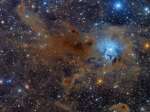 NGC 7023: The Iris Nebula
6.05.2016
These cosmic clouds have blossomed 1,300 light-years away, in the fertile starfields of the constellation Cepheus. Called the Iris Nebula, NGC 7023 is not the only nebula to evoke the imagery of flowers, though.
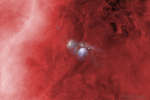 APOD: 2026 January 28 Б M78: Reflecting Blue in a Sea of Red
28.01.2026
In the vast Orion Molecular Cloud complex, several bright blue nebulas are particularly apparent. Pictured here in the center are two of the most prominent reflection nebulas - dust clouds lit by the reflecting light of bright embedded stars. The more famous nebula is M78, in the image center, cataloged over 200 years ago.
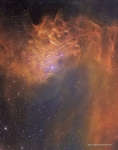 IC 405: The Flaming Star Nebula
7.01.2020
Rippling dust and gas lanes give the Flaming Star Nebula its name. The orange and purple colors of the nebula are present in different regions and are created by different processes. The bright star...
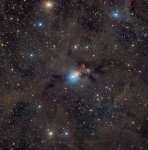 Stardust in the Perseus Molecular Cloud
18.03.2021
Clouds of stardust drift through this deep skyscape, across the Perseus molecular cloud some 850 light-years away. Dusty nebulae reflecting light from embedded young stars stand out in the nearly 2 degree wide telescopic field of view.
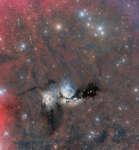 M78 Wide Field
21.01.2021
Interstellar dust clouds and glowing nebulae abound in the fertile constellation of Orion. One of the brightest, M78, is centered in this colorful, wide field view, covering an area north of Orion's belt. At a distance of about 1,500 light-years, the bluish reflection nebula is around 5 light-years across.
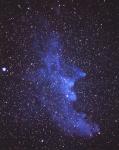 The Witch Head Nebula
9.02.1998
Double, double toil and trouble; Fire burn, and cauldron bubble ... Maybe Macbeth should have consulted the Witch Head Nebula. This suggestively shaped reflection nebula is associated with the bright star Rigel in the constellation Orion. More formally known as IC 2118, the Witch Head Nebula glows primarily by light reflected from Rigel.
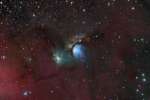 M78 Wide Field
26.11.2009
Interstellar dust clouds and glowing nebulae abound in the fertile constellation of Orion. One of the brightest, M78, is centered in this colorful, wide field view, covering an area north of Orion's belt. At a distance of about 1,500 light-years, the bluish reflection nebula is around 5 light-years across.
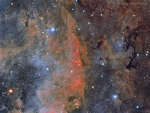 Colorful Star Clouds in Cygnus
22.04.2015
Stars can form in colorful surroundings. Featured here is a star forming region rich in glowing gas and dark dust toward the constellation of the Swan (Cygnus), near the bright star Sadr. This region, which spans about 50 light years, is part of the Gamma Cygni nebula which lies about 1,800 light years distant.
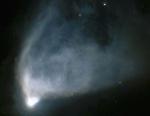 NGC 2261: Hubbles Variable Nebula
20.10.1999
What causes Hubble's Variable Nebula to vary? The unusual nebula pictured above changes its appearance noticeably in just a few weeks. Discovered over 200 years ago and subsequently cataloged as NGC 2661, the remarkable nebula is named for Edwin Hubble, who studied it earlier this century.
|
January February March April May June July August September |
|||||||||||||||||||||||||||||||||||||||||||||||||