
|
You entered: south pole
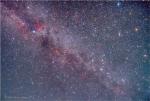 The Northern Milky Way
25.08.2003
Many of the stars in our home Milky Way Galaxy appear together as a dim band on the sky that passes nearly over the Earth's north and south poles. Pictured above is the part of our Galaxy that passes closest over the north pole.
 Ozone Hole Reduced
13.10.1999
Although a new ozone hole has formed again this year over the South Pole, this time it is a little bit smaller than the year before. Ozone is important because it shields us from damaging ultraviolet sunlight. Ozone is vulnerable, though, to CFCs and halons being released into the atmosphere.
 A Small Double Ozone Hole in 2002
22.10.2002
As expected, the ozone hole near Earth's South Pole is back again this year. This time, however, it's smaller than the past two years, and has an unusual double lobe structure. Ozone is important because it shields us from damaging ultraviolet sunlight.
 Invader From Earth
8.01.1999
These technicians are working on the solar-paneled Mars Polar Lander - yet another robotic spacecraft scheduled to invade the red planet. Mars Polar Lander is part of a series of missions focusing on a search for evidence of past or present life.
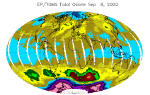 Antarctic Ozone Hole Widens
11.09.2000
It's back, and it's bigger than ever. The ozone hole that has been a cause of concern in recent years has again reformed over Earth's South Pole. The seasonal recurrence of the ozone hole was expected, although the size of the hole has never been so large this early in the season.
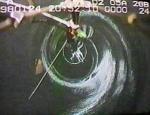 Ice Fishing for Cosmic Neutrinos
17.03.1999
In 1996, scientists melted a hole in the bottom of the world. In fact, several holes have been melted near the South Pole, and they are now being used as astronomical observatories. Astronomers with the Antarctic Muon and Neutrino Detector Array (AMANDA) lower into each vertical lake a string knotted with basketball-sized light detectors.
 Swiss Cheese Like Landscape on Mars
27.03.2001
Why do parts of the south pole of Mars look like swiss cheese? This little-understood landscape features flat-topped mesas nearly 4 meters high and circular indentations over 100 meters across. Since this swiss-cheese topography...
 Gemini South Star Trails
1.09.2006
Stars seem to arc through southern skies in this surrealistic time exposure -- recorded before moonrise from the Gemini South Observatory, Cerro Pachon, Chile, Planet Earth. During the one hour 40 minute exposure camera and tripod were fixed, so the concentric star trails are a reflection of Earth's daily rotation about its axis.
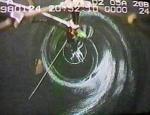 Ice Fishing for Cosmic Neutrinos
29.04.2001
Scientists are melting holes in the bottom of the world. In fact, several holes have been melted near the South Pole, and they are now being used as astronomical observatories. Astronomers with the Antarctic Muon and Neutrino Detector Array (AMANDA) lower into each vertical lake a string knotted with basketball-sized light detectors.
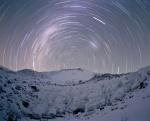 Star Trails at 19 000 Feet
2.12.2006
In myth, Atlas holds up the heavens, but in this stunning view a mountain appears to serve as the southern night sky pivots around a snowy peak. Recorded during a climbing expedition...
|
January February March April May June July August September October |
|||||||||||||||||||||||||||||||||||||||||||||||||